Friday, November 15, 2013

150th Anniversary of the Gettysburg Address/Cavendish in the Civil War

On  Nov. 19, 150 years ago, Abraham Lincoln gave his famous Gettysburg Address.


Following the July 1-3, 1863 Battle of Gettysburg, reburial of Union soldiers began on Oct. 17 of that year. The committee for the Nov. 19 Consecration of the National Cemetery of Gettysburg invited President Lincoln to speak. Lincoln’s address was so short, it was not possible for the camera’s of that day to capture a picture.

While Lincoln viewed the address as a “flat-failure,” and it received few favorable comments in the following days,  the speaker who spoke for two hours before the President, Edward Everett, grasped the significance of the speech. Everett wrote to Lincoln, “"I should be glad if I could flatter myself that I came as near to the central idea of this occasion in two hours as you did in two minutes."

Contrary to legend, Lincoln did not write the speech on the train to Gettysburg, but rather had been working on it for some time. In fact, he was kept so busy on the train, it would have been impossible for him to write it.

Throughout the trip, the President said he didn’t feel well. His complexion was poor and, as it turned out, Lincoln had a mild case of small pox. His valet William Johnson, also came down with the same illness on the trip, but unlike the President, he died from it. 


Four score and seven years ago our fathers brought forth on this continent, a new nation, conceived in Liberty, and dedicated to the proposition that all men are created equal.

Now we are engaged in a great civil war, testing whether that nation, or any nation so conceived and so dedicated, can long endure. We are met on a great battle-field of that war. We have come to dedicate a portion of that field, as a final resting place for those who here gave their lives that that nation might live. It is altogether fitting and proper that we should do this.

But, in a larger sense, we can not dedicate -- we can not consecrate -- we can not hallow -- this ground. The brave men, living and dead, who struggled here, have consecrated it, far above our poor power to add or detract. The world will little note, nor long remember what we say here, but it can never forget what they did here. It is for us the living, rather, to be dedicated here to the unfinished work which they who fought here have thus far so nobly advanced. It is rather for us to be here dedicated to the great task remaining before us -- that from these honored dead we take increased devotion to that cause for which they gave the last full measure of devotion -- that we here highly resolve that these dead shall not have died in vain -- that this nation, under God, shall have a new birth of freedom -- and that government of the people, by the people, for the people, shall not perish from the earth.
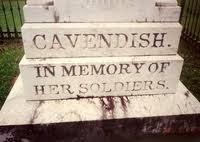

Take the time to read the Cavendish War Memorial in front of the Cavendish Historical Society Museum and you will see that the town provided 187 volunteers to the Union, a number of which were at Gettysburg .

In the History of Windsor County, edited by Lewis Cass Aldrich and Frank R. Holmes, 1891, the following account is given of Cavendish during this war:


- In the War of the Union. — The first action taken by the town in reference to the late civil war was at a town meeting held April 30, 1861, Governor Ryland Fletcher presiding. It was then voted to raise $2,000 to liquidate all obligations incurred by Captain Tuttle in raising the Cavendish Light Infantry, and to pay the board of the men and furnish support to their families. Another loan of $3,000 was authorized in August, 1862, to pay bounties for nine months' volunteers, and in November of the following year a bounty of $200 was offered for volunteers, which was subsequently increased to $300, and another loan of $4,000 negotiated. During the latter part of 1863 the bounty was increased to $500, to make it possible to fill the town quota, and the selectmen were authorized to raise $10,000 to pay the expense of future calls for volunteers. In January, 1865, another loan of $7,000 was made, and in 1867 $15,000 was borrowed to pay the balance of the war debt. From a compilation made by the Hon. Calvin French we give the following figures : Cavendish furnished to the armies of the Union twenty men in response to the first call for troops for three months' service. In the Second, Eleventh, Fourth, Seventh aud Fifth Vermont Regiments, forty-two men for three years' service. These volunteers received no bounties Forty-two men were furnished under the nine months call. For subsequent calls fifty-three men were furnished for three years, and thirty for one year, making a grand total of 187 volunteers furnished by the town, whose terms of service would amount to 3521^ years for one man. Of these 125 volunteers received bounties amounting to $43,550, the others being recruited before it was necessary to offer a bounty. As early as 1867 a movement was inaugurated to erect a soldiers' monument in Cavendish, but it was not successful. In May, 1883, the present secretary of war, Redfield Proctor, presented his native town with a fine white marble monument, suitably inscribed and surmounted with an eagle. The town at this time appropriated $1,000 to grade the lot and pay the expense of the dedication of the monument. 

For a small town, it is remarkable that Cavendish had three men receive the Congressional Medal of Honor for their service during the war- Tom Seaver, William Sperry and Daniel Davis Wheeler. 


SEAVER, THOMAS O.: Rank and organization: Colonel, 3d Vermont Infantry. Place and date: At Spotsylvania Courthouse, Va., 10 May 1864. Entered service at: Pomfret, Vt. Born: 23 December 1833, Cavendish, Vt. Date of issue: 8 April 1892. Citation: At the head of 3 regiments and under a most galling fire attacked and occupied the enemy's works.
SPERRY, WILLIAM J.: Rank and organization: Major, 6th Vermont Infantry. Place and date: At Petersburg, Va., 2 April 1865. Entered service at: Vermont. Birth: Cavendish, Vt. Date of issue: 12 August 1892. Citation: With the assistance of a few men, captured 2 pieces of artillery and turned them upon the enemy.
WHEELER, DANIEL D.: Rank and organization: First Lieutenant, Company G, 4th Vermont Infantry. Place and date: At Salem Heights, Va., 3 May 1863. Entered service at: Cavendish, Vt. Birth: Cavendish, Vt. Date of issue: 28 March 1892. Citation: Distinguished bravery in action where he was wounded and had a horse shot from under him.


Sunday, November 10, 2013

Visit CHS at the Holiday Fair 11/30/13


The Annual Cavendish Holiday Fair takes place on Saturday, November 30 from 9-3 at the Cavendish Town Elementary School in Proctorsville. Sandwiched between the shopping days of “Black Friday,” and “Cyber Monday,” the Cavendish Fair is all about local shopping with an emphasis on keeping the “green” not only in the holidays, but also in town.

New this year will be a “hand-made-by-you” workshop featuring Duct Tape offered by the Cavendish Historical Society (CHS) to benefit the Hands on History Program. From 10 am- 2pm you can learn to make one of the following items out of duct tape: wallet, tie, bows or a marshmallow blowpipe. The cost is $5 for one item or $10 for three items. All supplies are provided, including marshmallow ammo. Those who wish to make more of one item (Uncle Harry as well as Dad would like a Duct Tape tie) can do so for a materials fee of $3 per additional item.

Besides the various books and Cavendish related items, CHS is offering some unique products.  Check out the gift center for gardeners. There is a gardener’s sugar scrub, plant markers and gardening angels. There are also special holiday pillows and ornaments. The fair provides one last chance to purchase a ticket on the CHS raffle (including two pieces of Craig Rankin artwork), with the drawing taking place at 2 pm. CHS is hosting the Duct Tape workshop. Among the many Cavendish history items is Cavendish’s own Laura Ingalls Wilder, Sandra Stearns’s “Field Hill Farm.” In this book she describes her childhood in the 1940’s and 50’s on East Hill Rd in Cavendish.  

If you can't make the fair, but are interested in giving some Cavendish history this holiday, call 802-226-7807 or e-mail margoc@tds.net

Thursday, October 24, 2013

Pictures from the Stone Church

This morning, Thursday Oct. 24, members of the Stone Church Committee, crawled up into the belfry to check on conditions and to weatherize for winter. Below are some of the photographs taken by Bob Naess. Thank you to Bob, Pieter and Rolf van Schaik, and Rich Svec for showing up on such a cold day.

Looking west up Route 131. 

View of the Cavendish Cemetery


Pieter Van Schaik standing next to church bell.


Wednesday, October 23, 2013

Scribbler II Fall 2013


Visit CHS at the Holiday Fair
 The annual Cavendish Holiday Fair will be held at the Cavendish Town Elementary School multi purpose room on November 30. In addition to a variety of books and historical items, the Cavendish Historical Society (CHS) will have a number of interesting ornaments to reflect various aspects of Cavendish history.  In addition, with the help of some of our young historians, we will be offering a Duct Tape Gift workshop, where participants can learn how to make Duct tape wallet, marshmallow blowpipe (we include the marshmallows) and a beaded bracelet. The cost of the workshop is $5 per craft or $10 for all three. We will also have the drawing of the CHS raffle that afternoon.

Honoring Our Heritage: Dia de la Muertos
 In her book “Chubb Hill Farm and Cavendish Vermont: A Family and Town History, 1876-1960,” Barbara Kingsbury’s wrote in the 1994 addendum, Cavendish is not a closed society. Its history shows again and again that the town has assimilated strangers with different backgrounds and that these “strangers” have often proved asset to the community. Many who are now the “old-timers” were actually born in other places. The composition of Cavendish population is very different than it was a hundred years ago. It was more homogeneous then with a majority being farm families with English roots. Now there are people from many ethnic backgrounds, from different levels of education and income, and with a great variety of occupational and artistic skills.”

CHS’s program “Honoring our Heritage” shares the customs and traditions of the people who make up our community. This fall, we celebrate the people in our town whose heritage is South American. On November 2, CHS will be offering a free community wide Dia de la Muertos (Day of the Dead) workshop from, 3-5 pm at the Parish Hall of the Gethsemane Episcopal Church in Proctorsville.

An ancient Aztec celebration in memory of deceased ancestors, Dia de la Muertos (Day of the Dead) is celebrated on November 1 and 2. It is believed that on October 31, the gates of heaven are opened and the spirits of all deceased children are allowed to be reunited with their families for 24 hours. On November 2, the spirits of the adults come to enjoy the festivities. While celebrated throughout Latin America, it is especially popular in Mexico, where it is a national holiday.

Customs very from town to town and by region and country. In Brazil and El Salvador, on November 2, people go to church and visit cemeteries where they clean their ancestors graves and leave flowers. On November 1 in Guatemala the festival is a colorful and lively celebration for which extravagant kites (barriletes gigantes) are built and flown high above the cemeteries as a symbolic link between the living and the dead.

The workshop will include making papal picado (paper cuts), the banners that decorate many homes and streets; paper flowers; sugar skulls and more. For more information, please call 802-226-7807 or e-mail margoc@tds.net

What’s a Lime Kiln?
 This is a common question whenever we talk about the location of Phineas Gage’s accident. Close to where they were blasting for the railroad, and the tamping rod went through Gage’s head, there is the remains of a lime kiln that was built by Roswell Downer.

These kilns were used to create quicklime. By heating rocks or stone containing calcium carbonate limestone, to a temperature of 1000 C for hours up to several days, quicklime was created. This has been a key ingredient for centuries for plaster, mortar, and other types of construction materials. Watch a video of a lime kiln inaction. 

Cavendish’s Verde Antique Marble
 When you walk through the rotunda of the National Art Gallery of Art in Washington, D. C, did you know you were walking on Cavendish? The Verde Antique marble in the floor is from the Proctorsville Quarry. It was chosen because it was a match of the columns of the rotunda, which are made of Italian Verde.

In 1836, the Black River Marble and Soapstone Manufacturing company was established for extraction of the green serpentine rock -Verde Antique. The original quarry was located on the Black River, near Winery Road at a place formerly called Hart’s Bend. It was moved to its present location, off of Twenty Mile Stream Road in 1931 when Antonio Moriglioni operated the Quarry

Moriglioni was born in France, on route to the United States from Italy. He came to Rutland, VT in the early 1900’s and discovered the Verde Antique Marble. He owned and operated the quarry until the local mill owners squeezed him out of the business during World War II. With the mills, and other area businesses having military contracts, they needed the power and viewed the quarry as a “luxury item,” and not necessary for the war effort. Moriglioni never re opened the mill. Instead he went to work in a quarry in Sherbrooke, Quebec, Canada, where he died as a result of injuries he sustained from an explosion.

In 1989 the Ruby brothers, from Fair Haven, attempted to open the quarry but did not have the necessary equipment. In late 1990’s Vermont Quarries (owned by an Italian company) bought a 20-year lease to remove stone. The quarry was worked for 3-4 years and then work ceased. During this time,  stone was shipped for cutting to Italy, Spain and Brazil. 

Recently, members of the Moriglioni family-Lucille Moriglioni Evens, her brother James and his wife Barbara-presented the Cavendish Historical Society with pieces of the Verde Antique marble from their father's quarry. These are currently on display at the Museum. 

Cavendish Mills Timeline
 There have been a number of questions about the Mills in the town of Cavendish. To help answer these questions, below is a timeline.

1832: The Black River Canal and Manufacturing Company is constructed in Cavendish. It was the first stone building in town. It burned in 1873. On the Beers Atlas in 1969, it was listed as Frederick Fullerton & Co Woolen Mill.

1836: The Proctorsville Woolen Mill started. Failed in the panic of 1873-74 and was not used for three years. It was reopened with new owners in 1877 and became known as the Crescent Woolen Mill. This Mill was to undergo a number of different names and ownership as follows:
• 1890: Murdock’s Mill-A large brick addition of four stories was built and the machinery was increased to 12 sets of cards and sixty broad looms and employed 175 people
• 1927-Proctor Mill
• 1932- 1937-Black Bear Woolen Mill

Proctorsville bought the building in 1938. In the 1940’s this building was used by Proctor Reels to make furniture as well as reels. The building eventually housed Acousti-Phase, which burned in 1982. Part of the Mill area is now the Proctorsville Green.

1867: Spring Mill (known as Fitton Mill) started in 1867 and burned in 1875. The fire was thought to be arson.  However, according to an article found in “The Chronicle: A Weekly Journal, Devoted to the Interests of Insurance, Manufacturing and Real Estate, Vol 16 1875  there may have been another cause, “The destruction of Fitton’s Mill at Cavendish, VT, September 6th, awakens attention to the value of woolen-mill property, and what security there is in lighting rods. This mill was a four story frame building...built in 1865...In the ten years’ service it had depreciated 36 per cent, not withstanding repairs had been regularly kept up and the structure was in profitable use. This building was flat roofed, graveled and had an unusually large array of lightening rods, one every four feet about the eaves. These were all in good order, all connecting, having been thoroughly overhauled within a year , and yet the mill was struck during a heavy storm, while the watchman was within. The flames seemed to flash instantaneously throughout the spinning room.

1887: Gay Brothers Mill opens on the site of the Black River Canal and Manufacturing Company. The Gay brothers operate the Mill until 1951 when it is sold to F.C. Hyuck and Sons, and renamed Kenwood Mills. Operations were discontinued in 1957 and the building was sold to a Rutland firm. In 1962 Mac Molding purchased the building and continues to use it for injection plastic moldings.

Aleksandr Solzhenitsyn: Words of Truth Change History
During one of the CHS “Hands on History” programs for students, Aleksandr Solzhenitsyn’s experience as a Captain in the Russian Army during WWII was included along with the stories of the other Cavendish veterans. One of the students became extremely upset about how Solzhenitsyn was arrested on the front lines and imprisoned just because he wrote to a friend about his concerns with Stalin. She kept on saying “this is unfair” and had a hard time understanding that he eventually was released, wrote of his experiences and helped to free his country from communism. By showing her pictures of Solzhenitsyn living in Cavendish, his children and grand children, we were able to ease her angst.

This student’s strong reaction to Solzhenitsyn’s story was the catalyst for the writing of a children’s biography Aleksandr Solzhenitsyn: Words of Truth Change History. Having a book she could read, might be a better way for her and other students to understand that Solzhenitsyn’s experience in war was literally just one chapter in a very amazing life.

The Solzhenitsyn family has been involved in the development of the book, geared for students in grades 4-7, and will include a number of new photographs. The anticipated publication date is late spring/early summer. Several grants have been written to help with the editing, layout, and marketing of the book. All proceeds will go to CHS to help with the restoration of the Stone Church and the Solzhenitsyn permanent exhibit-I Wrote and Waited.


Cavendish Historical Society Board
Dan Churchill
Jen Harper
Gloria Leven
Bruce McEnaney
Mike Pember
Gail Woods

Coordinator: Margo Caulfield
Contact Information: margoc@tds.net 802-226-7807
www.cavendishhistoricalsocietynews.blogspot.com


Upcoming CHS Activity Dates
 November 1 (Friday): Dia de la Muertos Hands on History workshop for the 5th grade students at Cavendish Town Elementary School (CTES).

November 2 (Saturday): Community wide Dia de la Muertos workshop  from 3-5 at the Parish Hall of the Gethsemane Episcopal Church in Proctorsville. This is free and open to the public.

November 3 (Sunday): 85th anniversary of the 1927 Flood that caused considerable damage to Cavendish.

November 6 (Wednesday): Early Settlers Hands on History workshop for students in grades 1 and 2 at CTES

November 30 (Saturday): Cavendish Holiday Fair at CTES multi purpose room. Stop by the CHS booth.

December 11 (Wednesday): 95th birthday of Aleksandr Solzhenitsyn
BECOME A MEMBER, RENEW YOUR MEMBERSHIP, DONATE: If you have not joined the Cavendish Historical Society, need to renew your membership, and/or would like to be a volunteer, please complete the form below and sending a check, payable to CHS, to CHS, PO Box 472, Cavendish, VT 05142. All contributions are tax deductible.

Name: _______________________________________

Address: _______________________________________________


Phone Number: _____________________    E-Mail: ____________________________
Membership Level
__ Individual Member $10        ___ Senior Member 65+ $5  ___ Sustaining Member $500
__ Household Member $15      ___ Contributing Member $250                                

Volunteer
___ I would be interested in serving, as a volunteer .I would be interested in serving on the following committee(s):
__ Program Planning     __ Fundraising            __ Building (Museum)
__Archives                       _ Budget       ­­–– Cemetery  __ Hands on History

Donations are always welcome and can be designated as follows:
__ For general purposes            __ Educational Programs         __Publications
__ Archeological Activities       __ Museum & Archival           __ Special Events
__ Rankin Fund                         __  Williams Fund                    __ Hands on History
__ Other (please specify)         __ Cemetery Restoration