The Cavendish Historical Society's accepts tax-deductible contributions to help preserve our history. You can reach us at margocaulfield@icloud.com 802-226-7807 or PO Box 472 Cavendish, VT 05142 The CHS Museum is located at 1958 Main Street (Route 131) in Cavendish.
Armistice Day is commemorated every year on November 11th
to mark the armistice signed between the Allies of World War I and Germany at
Compiègne, France. It took effect at eleven o'clock in the morning—the
"eleventh hour of the eleventh day of the eleventh month in 1918. This
year marks the 80th anniversary of the Armistice.
Cavendish had 57 men and one woman serve in the war. A few
families had two members of their family serving but the Pollards had four sons
and one daughter, Mary, who was a dietician in an Army Hospital on Ellis
Island.
Of those serving, four died: George Dixon, Winthrop Hoyle, Truman
McNulty and Francis Wallace. Hoyle was only 16 and died of nephritis in Rhode Island,
while the other three died from what was known as the “Spanish Flu.”
Killing between 50-100 million people around the world, this
flu was more deadly than WWI where nine million men were killed in combat and
another twenty one million wounded, many of whom were left without arms, legs, noses, and
even genitals, while others suffered the remainder of their lives from mustard
gas.
As history was to show, the seeds for WWII were laid in the
Armistice, which in effect was a surrender. German civilians, due to
what we would call today “fake news,”were not aware that their military had been defeated and were outraged
to learn of the Armistice terms and to see British, French and American
occupation troops in their homeland. It isn’t surprising that Hitler could
pedal his message that the Army was robbed of its victory by socialists,
pacifists and Jews.
While much is made of the 11th hour, the 11th
day of the 11th month, the final six hours after the signing of the
Armistice, which occurred at 5 am, was a blood
bath. On that date, twenty-seven
hundred and thirty-eight men from both sides were killed, and eighty-two
hundred and six were left wounded or missing, with the vast majority of these
casualties happening after the Armistice had been signed, where there was no
political or military gain. The day’s toll was greater than both sides suffered on D Day in 1944.
Among the many victims were
troops of the American 92nd Division, part of Bullard’s Second Army. The U.S.
military was rigidly segregated, and the men of the 92nd were black. All their
higher-ranking officers, however, were white, often Southerners resentful of
being given such commands. “Poor Negroes!” Bullard, an Alabaman, wrote. “They are
hopelessly inferior.” After already enduring discrimination and fear at
home—sixty black Americans were lynched in 1918 alone—and being treated as
second-class citizens in the Army, these troops found themselves, after the
Armistice had been signed, advancing into German machine-gun fire and mustard
gas. They were ordered to make their last attack at 10:30 A.M. The
92nd Division officially recorded seventeen deaths and three hundred and two
wounded or missing on November 11th; one general declared that the real toll
was even higher. A Hundred Years After the Armistice
Please check the Cavendish VT Facebook page for photo albums of various CHS activities.
WHAT
WE’RE DOING
Miles Glidden talking about Homer who
visits PVFD
Carmine Guica Young
Historians:Cavendish Historical Society (CHS)
spends a lot of time working with youth, not only to teach them town history
but to also instill good citizenship through stewardship. We are pleased to
report that Cavendish has almost no vandalism of town property and starting
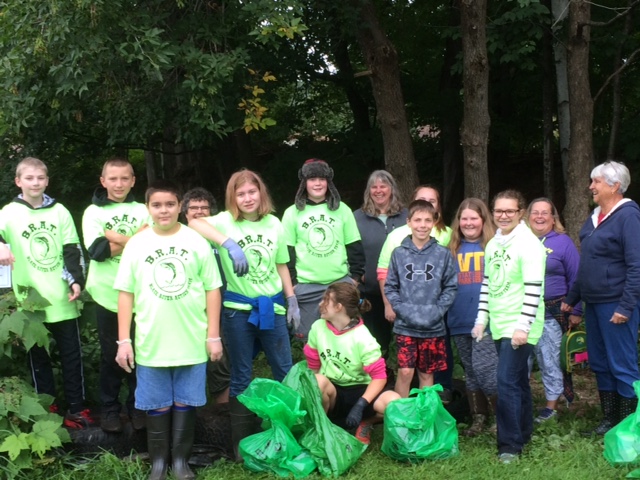
with this fall’s RiverSweep, we can see that the beach area along the Black
River is much cleaner and in better condition than ever before.
The Blacksmith Shop at Sturbridge is popular with studens
October
has been a very busy month. We had the first ever Foliage/History Tour on the Green Mountain Railroad for the Cavendish Town Elementary School (CTES) 4th grade and students from Green Mountain Union High School (GMUHS). The 6th graders once again visited Fitton Mill, as well as Sturbridge Village. Rounding out the month was the 5th graders annual Proctorsville Ghost Walk.
Nov. 1 the 5th graders will take part in a
Dia de los Meurtos (Day of the Dead) celebration and on Nov. 9 will learn more
about first peoples in Vermont by making pottery, using stone tools and
traditional story telling.
In December, the entire school will take part in a daylong
series of workshops pertaining to Scandinavia. Included will be a “taste of
Sweden, Norway and Denmark.” This annual tradition is one way students learn
about the people who helped found Cavendish and gain a better understanding
of their culture and traditions.
While many Scandinavians were recruited to work in the
mills, the Swedes were also recruited to set up farms in Vermont. The latter
was not considered a successful venture as many moved to other parts of
the country. Interestingly, a second wave of Nordic immigrants came to the area
because of the developing snow sports industry.
Thank you to our incredible volunteers this month
including Bruce and Timothy McEnneny. Special thanks to Julie and Mike of the Golden Stage Inn, who once again amazed the students with stories of hauntings at the Inn. Our trips are made possible by
contributions from Stein van Schaik and the McEnneny’s Blueberry Fund.
Vermont
Native American Timeline: If you missed the last talk of the
season, honoring Indigenous Peoples Day, check out the CHS blog post VT NativeAmerican Timeline.
Included on the timeline is a video of state archeologist Jess Robinson
discussing Vermont pre European contact.
Solzhenitsyn: We are thrilled that the
long awaited Aleksandar Solzhenitsyn book Between Two Millstones: Sketches of Exile, 1974-1977, which covers the
first two years of his life in Cavendish, is now
available in English.
We
know that many are interested in how Cavendish will be celebrating Solzhenitsyn’s
100th birthday. We are finalizing plans and will be posting more information
in the next few weeks in the CHS newsletter as well as in the newspaper,
on-line etc. In the meantime, on Nov. 15, Margo
Caulfield of CHS will speak on Solzhenitsyn’s Life in Cavendish as part of the
third Thursday series of the VT Historical Society (VHS).
The talk will take place at noon at University Heights South
(2&3), University of Vermont in Burlington. Directions are available on-line.If you are unable to
attend, you can watch and ask questions via the VHS Facebook page.
If
you have questions or wish to volunteer with CHS, please call 802-226-7807,
e-mail margocaulfield@icloud.com
or mail PO Box 472, Cavendish, VT 05142
Aleksandr Solzhenitsyn, the Nobel Prizing writing writer and
Soviet dissident, spent 18 of his 20 years in exile in Cavendish, VT. With the
publication of Between Two Millstones:
Sketches of Exile, 1974-1977 now there is more than a
glimpse of what life was like for him during this time.
"Between
Two Millstones" contains vivid descriptions
of Solzhenitsyn's journeys to various European countries and North American
locales, where he and his wife Natalia (“Alya”) searched for a location to
settle their young family. There are fascinating descriptions of one-on-one
meetings with prominent individuals, detailed accounts of public speeches such
as the 1978 Harvard University commencement, comments on his television
appearances, accounts of his struggles with unscrupulous publishers and agents
who mishandled the Western editions of his books, and the KGB disinformation
efforts to besmirch his name. There are also passages on Solzhenitsyn's family
and their property in Cavendish, Vermont, whose forested hillsides and harsh
winters evoked his Russian homeland, and where he could finally work undisturbed
on his ten-volume history of the Russian Revolution, The Red Wheel. Stories include the efforts made to assure a
proper education for the writer's three sons, their desire to return one day to
their home in Russia, and descriptions of his extraordinary wife, editor,
literary advisor, and director of the Russian Social Fund, Alya, who
successfully arranged, at great peril to herself and to her family, to smuggle
Solzhenitsyn's invaluable archive out of the Soviet Union.Notre Dame Press
For
Vermonters, Senator Patrick Leahy summed it up when he wrote, “Aleksandr
Solzhenitsyn took to Vermont and Vermonters took to him. I felt it a privilege
to have met with him in his new Vermont setting, and I know that our state’s
forested beauty reminded him of home. We are proud that he believed that his
homeland, and the world, could learn from the local self-government that is
embodied in Town Meeting Day in towns and hamlets across the Green Mountain
State.”
There were differing
ideas of how Solzhenitsyn lived in Cavendish- a self -imposed “gulag,” to a
lavish lifestyle in a “gated” compound. However, the truth was quite different.
The suddenness of our move caught
everyone’s attention: it is unacceptable for people of fame not to inform the
world of what they are doing, not to advertise their next move but to go ahead
and do what they want unannounced. Over a hundred press vehicles now converged
on the tiny town of Cavendish from Boston, from New York, quizzing the
townspeople to get information, journalists crowding in front of our gate,
scurrying along our fence—they even arranged for a helicopter to fly over our
property and take pictures. ....To make things worse, our light chain-link
fence had a single strand of barbed wire on top where the fence ran along the
side of the road, to hook the pants of snoopers trying to climb over. This
single strand of barbed wire the media now magnified into a “barbed-wire fence
surrounding the entire property,” and that it was if I were willing myself up
in a new prison, a “self-imposed gulag.” I did intend to sequester myself, not
in a prison but in a tranquil refuge, the kind necessary for creativity in this
mad, whirling world. But the press also picked up details from the locals about
us having a pond, setting off the legend about my “swimming pool,” which
immediately turned our supposed life within a prion into a “bourgeois
lifestyle” in which the Solzhenitsyn family now intended to indulge. Ah,
wretches, they were writing not about us but about themselves, revealing what
mattered to them. We have been expelled from our country, our hearts are
constricted, my wife’s eyes are never dry of tears, only work can save us—and
that is our so-called “bourgeois lifestyle.”
Between Two Millstones is available at Amazon in both hardcover and Kindle formats.
UPDATED OCTOBER 2019 Note that there are various videos listed at the end of this article, including the film made about the Paleoindian dig at Jackson Gore.
9,500 > Years ago Paleo-Indian Era (Stone Age culture) As the Laurentian ice sheet
retreated north,the first peoples
entered VT around 12,500 year ago. Champlain Sea. Warmer than in other
locations. Mastodon and mammoth. They traveled as well as traded-stone, which
was from New York, Quebec, Maine, Pennsylvania, Ohio and other places. Small
groups, less than 10.
3,000-9,500 Years Ago: Archaic Period. Warmer temps helped to shape many kinds of wetland
from lakes and ponds to swamps and bogs. Champlain Sea shrunk turning from salt
water to fresh water. Lake Champlain was likely lower than its present day
level. Hardwood forests appear-beech, oak, ash and maple. Rely on more local
stone in VT. Groups began moving to different areas for season. The
presence of a large variety of woodworking tools in Archaic assemblages suggest
that water crafts were used for travel, fishing, and probably other animal
procurement activities. In the latter part of the archaic period, fruit and nut
bearing trees began to grow and native populations expanded with communities
being forming.At the end, temperatures
drop
Early Woodland 2,000-3,000: Preferred not to live in the higher
elevations and spend most of their time in the warmer river valleys. Population
decreases. Cemeteries from this period Pottery Bow and Arrow. Connected with
people in Ohio and across the Northeast. These were spiritual people who were
deeply connected to their ancestors and to the land
Middle Woodland 1,000-2,000 Temps began to rise and with it an
increase in population. Once again using stone from far away places for stone
tools. Dugout canoes have been found throughout the Champlain Valley. Native
Americans in the region had developed a culture based on the selective
borrowing of ideas and innovations from other people with whom they had come in
contact over the past 9000 years. The people of the Woodland Period were
becoming more sedentary in their living habits, and established substantial
settlements on the floodplains of major rivers, such as the Winooski and Otter
Creek. The subsistence patterns of prehistoric Champlain Valley residents
gradually changed from mobile hunting and fishing parties to a dependence upon
horticulture and the gathering of a greater diversity and quantity of wild
plant foods.
Pre European Contact -1,000 Temps remained steady or slightly
increased. Pottery expanded and see pipes for the first time-ceramics.
Cultivation of crops-three sisters (corn, beans and squash). Agricultural tips were
passed through trade networks. First existence of farming in New England occurs
in VT in the 12th Century.
1535: Jacques Cartier (1491-1557) is first
European to sight Vermont. Attempts to develop trade relations with the St. Lawrence
Iroquois and other tribes living along the banks of the St. Lawrence River. The
French attempt to establish a colony in the St. Lawrence Valley during the
sixteenth century failed, although sporadic trade for furs in exchange for
metal tools did occur between the French and the St. Lawrence tribes. By 1603, the diseases which the St. Lawrence Iroquois
contracted from the French spread quickly throughout the Champlain Valley,
decimating the native population. The struggle over French trade also caused
great unrest in the Champlain Valley. The Mohawk Iroquois, who inhabited
primarily the Mohawk Valley, became the dominant tribe from Quebec to
Connecticut. By 1609 the Western Abenaki had retreated from the Champlain
Valley in an effort to escape destruction at the hands of the Mohawk.
1688: 1688 - 1763 The French and Indian Wars between France and
Great Britain for lands in North America consisting of King William's War
(1688-1699), Queen Anne's War (1702-1713), King George's War (1744 - 1748) and
the French and Indian War aka the Seven Years War (1754-1763)
1688: (1688-1699) King
William's War (part of the French and Indian Wars) between France and the
Wabanaki Confederacy and England and the Iroquois Confederacy. Peace
Treaty made at Pemaquid. August 11,1693. and was ratified on Jan. 7. 1699
1702: (1702-1713) Queen
Anne's War (part of the French and Indian Wars) between the French and Spanish
colonies allied with the Wabanaki Confederacy, Mohawk, Choctaw, Timucua,
Apalachee and Natchez tribes against the British colonies allied with the
Muscogee (Creek), Chickasaw and Yamasee tribes.
1744: (1744–1748) King
George's War (part of the French and Indian Wars) between the French colonies
allied with the Wabanaki Confederacy and the British colonies allied with
Iroquois Confederacy
1775: 1783 The American Revolution. 1776: July 4, 1776 - United States
Declaration of Independence 1780: Last major Indian raid, led by the
British, in Royalton 1812: 1812 - 1815: The War of 1812 between
U.S. and Great Britain, ended in a stalemate but confirmed America's
Independence 1830: Indian Removal Act 1832: Department of Indian Affairs
established 1861: 1861 - 1865: The American Civil War. 1862: U.S. Congress passes Homestead Act
opening the Great Plains to settlers 1887: Dawes General Allotment Act passed by
Congress leads to the break up of the large Indian Reservations and the sale of
Indian lands to white settlers 1931:
Vermont approved its sterilization law. Eugenics. Poor and
socially ostracized families were targeted for investigation of the three D’s
(delinquency, dependency, and mental defect). These families usually lived
“outside the accepted moral or social convention of middle class America”
(Gallagher, p. 37). The three D’s were used to target the poor, the disabled,
French-Canadians, and Native Americans. Women were targeted more than men.
French-Canadians and Abenakis were seen as a foe and
threat to the early colonial settlers of Vermont. They represented “an
insidious and continuous invasion” of Vermont and were therefore targeted
(Gallagher, p. 45). Studies done on degenerate family lines were often
traced back to French Canadian or Native American ancestry and were used to
target these groups (Gallagher, pp. 80-82). the last noted sterilization in
Vermont occurred in 1957, between 1973 and 1976, approximately 3,400 Native
American women, according to the General Accounting Office, were sterilized in
the United States without properly obtaining consent (Dowbiggin, p. 181; see
also Forbes 2011). 1969: All Indians declared citizens of U.S. 1979: American Indian Religious Freedom Act was
passed
Yes the new doors for the
Museum are finally being hung! Things always seem to take longer than we plan
on and as a result, the Museum has been closed for the last two weeks. We hope
the doors will be working so we can hold our last program of the season at the
Museum on Oct. 7- 1st Peoples of the Americas and Vermont. In the
event that construction is still underway, we will post notices at the
Cavendish VT Facebook page and CHS blog.
Special thanks to Bob Naess and Dave Stern for their ongoing efforts on this project.
WHAT WE’RE DOING
Carmine Guica Young Historians: Between taking the
Cavendish Town Elementary School (CTES) 5th and 6th
graders to Constitution Day at Coolidge,
RiverSweep, and blueberry
picking, the school year is off to a good start. October includes a special
workshop on 1st Peoples for the 5th graders as well as
the annual trip for the 6th grade to Sturbridge Village. For the
first time we will be taking the 4th grade, along with a few
students from Green Mountain Union High School, on the Fall Foliage Train History
Tour.
Thank
you to our incredible volunteers Doris Eddy, Bruce McEnneny, Peggy Svec, and
Pang Ting. None of this would be possible without the contributions from Stein
van Schaik and the McEnneny’s Blueberry Fund.
Solzhenitsyn:. While Margo Caulfied spoke at the Reading
Solzhenitsyn: An International Conference at Northern Vermont University on
Sept. 7, it was exciting to host so many conference speakers the following day
in Cavendish.
Upcoming activities include:
• October
15: Publication of “Between Two Millstones, Book 1.”
Fast-paced, absorbing, and as compelling as the earlier installments of his
memoir The Oak and the Calf (1975), Between Two Millstones
begins on February 12, 1974, when Solzhenitsyn found himself forcibly expelled
to Frankfurt, West Germany, as a result of the publication in the West of The
Gulag Archipelago. Solzhenitsyn moved to Zurich, Switzerland, for a time
and was considered the most famous man in the world, hounded by journalists and
reporters. During this period, he found himself untethered and unable to work
while he tried to acclimate to his new surroundings. There are passages on
Solzhenitsyn’s family and their property in Cavendish, Vermont, whose forested
hillsides and harsh winters evoked his Russian homeland, and where he could
finally work undisturbed on his ten-volume history of the Russian Revolution, The
Red Wheel.
• The
Solzhenitsyn exhibit continues at the Vermont Historical Society Museum in
Montpelier until October 20.
• November
15: Vermont Historical Society at the University Heights South, Room 133.Presentation by Margo Caulfield “I Wrote and
Waited": Aleksandr Solzhenitsyn’s Life in Cavendish, VT
• Margo will
also be doing a presentation for the Oshler Center for Life Long Learning at
Dartmouth. Date to be announced.
SAVE THE DATE
Oct. 7 (Sunday): 1st Peoples of Cavendish Talk
will focus on the earliest occupants of the land, dating back 11,000 years ago.
It will include a discussion of how North America became occupied and evidence
of first occupation in Cavendish. The talk begins at 2 pm.
HOW YOU CAN HELP
If you can help with any of the following, please
contact CHS margocaulfield@icloud.com; 802-226-7807 or PO
Box 472, Cavendish, VT 05142
• Baby
Boomers: Recently CHS acquired a fan from the 1950s and it has sparked a
conversation that we have far more examples of life in 1800s Cavendish then we
do from more recent times. If you have items you would like to donate, CHS is working
on a “Life in Cavendish-Baby Boomer Style.”
• CHS is looking for new board members as well as
volunteers who can help with various activities.
New doors are being installed in the Cavendish Historical society (CHS) Museum. Consequently the Museum will be closed on Sunday, Sept. 23. We regret any inconvenience. To arrange for a visit at another time, please call 802-226-7807 or e-mail margocaulfield@icloud.com