Monday, November 23, 2020

CGYHU for December 2020

Below is the Carmine Guica Young Historians Update for the upcoming month of December.


Dec. 21, is winter solstice and many cultures celebrate the returning light. This month’s hands on history kits reflects this theme with the following items, which you can collect from the CHS Cares Closet or order for your class or student by e-mailing margocaulfield@icloud.com or calling 802-226-7807.


• Ready to paint plaster items.
During Saturnalia, source of various Christmas traditions, sun ornaments made out of gold were frequently given. These are light enough that they can be hung on a tree. I’d recommend using a strong glue like E 6,000 in order to add a ribbon. Magnetic strips will also work for frig magnets.


Dreidels: Includes direction.

                                                How to play the Dreidel Game


Kente Cloth to color: In recognition of Kwanzaa, we have a Kente Cloth pattern on card stock which can be colored. A brief summary of Kwanzaa and Kente cloth are on the reverse side. Good resource for teaching kids about Kente cloth and provides a paper weaving project.


• Origami Cranes: In Japanese, Chinese and Korean traditions, the crane stands for good fortune and longevity. More recently is has become a peace symbol thanks to the story of SadakoSasaki, who developed Leukemia as a result of the bombing of Hiroshima and tried to make 1,000 cranes to achieve the wish of health. Recommend this project for older students. These cranes look beautiful on a Christmas tree.


Learn to make a crane by watching this video. 


To string the crane, watch the following video. 


Historical Dates for December

Dec. 1 1955: The birth of the modern American civil rights movement occurred when Rosa Parks was arrested in Montgomery, Alabama, for refusing to give up her seat to a white man and move to the back section of a municipal bus.


Dec. 2, 1859: Abolitionist John Brown was executed for treason following his raid on the US Arsenal at Harper’s Ferry.


Dec. 6, 1865: The 13th Amendment to the US Constitution was ratified abolishing slavery.

-       St. Nicholas Day


Dec. 7, 1941: The US Naval base at Pearl Harbor, HI was bombed, killing nearly 3,000 Americans dead. The US declared war on Japan the next day.


Dec. 10-18: Hanukkah is a Jewish festival commemorating the re dedication of the Second Temple in Jerusalem at the time of the Maccabean Revolt against the Seleucid Empire. Also known as the Festival of Lights.

                                                        The Story of Hanukkah for Kids 


Dec. 11, 1918: Aleksandr Solzhenitsyn was born in Russia. The 1970 Noble Prize winner in literature and the Templeton Prize winner in 1983, Solzhenitsyn lived in Cavendish for 18 of the 20 years he was exiled from Russia. While here he wrote the Red Wheel. CHS has written a book for 4th-7th graders The Writer Who ChangedHistory: Aleksandr Solzhenitsyn. If there is interest in having a group of students read the book and discuss it, we can arrange for a Zoom discussion.


Dec. 13:Saint Lucia’s Day 


-       1773: The Boston Tea Party


Dec. 21: Winter Solstice (the shortest day of the year) National Geographic video


Dec. 25: Western Roman Catholic Church started the tradition of Christmas in 336 AD. It was based on the tradition of Mithra, god of the sun, who was believed to be born on Dec. 25,


-       Washington crossed the Delaware


December 26-January 1 - Kwanzaa, an African American family observance established in 1966 celebrating traditional African harvest festivals, focusing on family unity, with a community harvest feast on the seventh day. Kwanzaa means "first fruit" in Swahili. Learn more about Kwanzaa by watching this video.


Dec. 31st: New Year’s Eve


Sunday, November 8, 2020

National Native American Heritage Month 2020

November is National Native American Heritage Month To honor the Abenaki, the indigenous peoples of Vermont (VT)-the Elnu tribe covers southern VT-and the first people of the Americas, the Cavendish Historical Society (CHS) has compiled resources and videos. While Covid is making it hard for people to gather as they have done in years past, there are variety of on-line activities taking place.


On Veteran’s Day, Nov. 11, the National Native Americans Veterans Memorial will be dedicated in Washington D.C. This can be watched live or at a later date at the National Museum of the American Indian (NMAI) website.


                        Making History: The Bigger Story Kevin Gover 


Vermont Resources

Vermont Native American Timeline

Susannah Johnson/Indian Stones/Captive Johnsons Cavendish birth


                                                  Abenaki Ways of Knowing Water


Nationally

National Museum of the American Indian (part of the Smithsonian).  


Native CinemaShowcase. Stream some of the best in Native film 


• NMAI Exhibition websites 


PBS NativeAmerica  Be sure and check out the Iroquois Confederacy and the role it played in the formation of the US Constitution. /


CelebratingNative American Heritage Month-What to Watch: List of films that can be downloaded from the PBS website.


• About NativeAmerican Heritage Month


Thanksgiving

With Thanksgiving just around the corner, learn more about what actually happened NMAI’s American Indian Perspectives on Thanksgiving 

-        The Invention of Thanksgiving 


-       Do American Indians Celebrate Thanksgiving 

-       Fall CHS Newsletter that explores Thanksgiving origin story


Monday, November 2, 2020

CHS Briefs November 1, 2020

UPCOMING EVENTS:


Nov. 15 (Sunday):
Book 2 of “Between Two Millstones” by Aleksandr Solzhenitsyn publication date. In this book, he reflects on life in Cavendish. The fall Scribbler II contains an excerpt from the book.


Christmas Ghost Walk Proctorsville: Date to be announced.


NEW AT THE CHS BLOG

"Twenty Mile Stream Grave Robbery," a story from Mary Churchill with information about the practice of grave robbing to assist students at Woodstock Medical College in learning anatomy. Happy Halloween from the Cavendish Historical Society.


CGYH Update for November: Lots of resources for celebrating November, which is  Native American Heritage Month as well as the 400th anniversary of the landing of the Mayflower as well as Thanksgiving.


• Fall Scribbler II: CHS’s newsletter


Proctor Cemetery

CARMINE GUICA YOUNG HISTORIANS PROGRAM:
CTES 4-6th grade students have been actively involved in CHS’s Preserve and Serve program. The Proctor Cemetery is getting much needed help from the 6th graders, who have been removing leaves and preparing for the winter ahead. They will be back working in the cemetery this month. The 4th and 5th graders have been doing fall lawn care in Proctorsville.


Fall is the time for the 5th graders Ghost Walk, and we are very appreciative of the Golden Stage Inn Keepers (Julie and Mike Woods) who keep us all spell bound with the hauntings that continue to take place there. Every year they have a new story.


The 5th graders will be doing the ghost walk on Nov. 2, since it wasn’t possible to do the walk last year due to the closure of the Depot St. Bride to foot traffic.


Since visitors are not allowed in the school, CHS has been running programs outside or providing “hands on history kits” for both in school and home learning students.


HALLOWEEN:
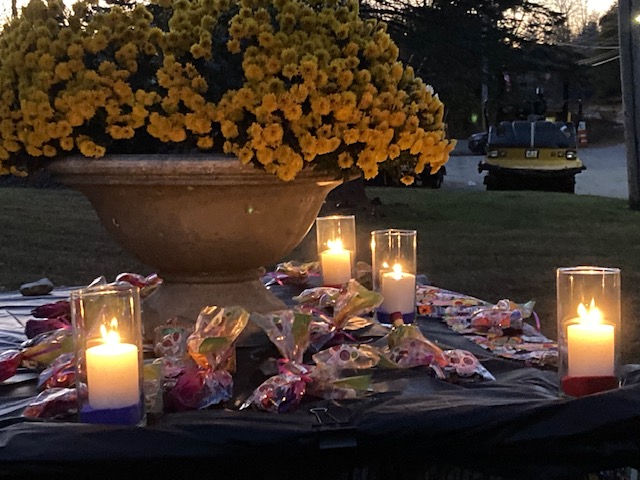
For the first time, CHS was part of Cavendish’s Halloween celebration. We opened up the CHS Cares Closet so people could take books, puzzles, craft supplies for the winter ahead. In addition, we set up a Dia de los Muertos (Day of the Dead) table with special bags of treats. Looks like this could be the start of a new tradition. Maybe next year we can create some interesting shadow puppets for the window of the Museum.


CHS CARES CLOSET: We’ve been hearing from some of our locals who can’t make it to the Closet due to weather, sickness, or finding it difficult to get out. To help our community during this time, we can arrange to drop off books, puzzles, art supplies or even masks, to help families stay safe and entertained. Please e-mail margocaulfield@icloud.com with your requests. All items will be placed on the porch, mail box or a designated spot.


If you have items you’d like to donate to the Closet, please call 802-226-7807 or e-mail margocaulfield@icloud.com


HANDS ON HISTORY KITS: Kits planned for December will include recognition of Winter Solstice and holidays associated with that date.


COVID-19: CHS continues to collects items, stories etc. associated with the pandemic for archival purposes. If you have something you would like to donate, please contact us.


Wednesday, October 28, 2020

Twenty Mile Stream-Grave Robbery

For Halloween, and Dia de los Muertos (Day of the Dead) this year, the Cavendish Historical Society (CHS) will be distributing treats (appropriately socially distanced) as well as providing a chance for anyone who wants to pick up a book, puzzle, CD etc. as part of our one night expanded CHS Cares Closet. Hours are 4-7 on Saturday, Oct. 31. If you have questions, call 802-226-7807 or e-mail margocaulfield@icloud.com


In keeping with Halloween, below is one of the  stories  from “Cemeteries of Cavendish, Vermont 1776-1976 Bicentennial Project” by Mary Churchill. Following the story is more information on the practice of “grave robbing.”


Oliver Whitney, Sr., lived on a farm northwest of the so-called Bates Farm on Twenty Mile Steam. Part of the farm was in Ludlow and part was in Cavendish. It is now included in the Bates farm.


Sometime in the early 1800’s, perhaps 1820 or so, James Whitney, son of Oliver, was ill from a cause doctors were unable to diagnose. The boy became morbid and seemed to have an overpowering presentiment that “the doctors” as he expressed it, would endeavor to possess his body after his decease because they could not determine the cause of his illness. He knew there was a Medical College in Woodstock and also knew medical students that had to rob graves in order to get their cadavers. He begged his brother, Oliver, Jr, to solemnly promise he’d guard his grave for as long a time as he felt it necessary. Oliver, to allay his brother’s fears, promised, altho’ he hardly believed there was any danger.


Whitney Grave

James died on Saturday in July and was buried in the Twenty Mile Stream cemetery near some Whitneys. They were Oliver, who died 10-3-1865 aged 75 years and 11 months, Mehitable d 5-31-1863 aged 75 yrs and Sarah who d 12-9-1843 yrs. Perhaps they were James grandparents. That night his brother, Oliver, accompanied by Robert Barrett, a next door neighbor’s boy who lived on the Ashton Spaulding farm just west of the Bates’ Mansion (now known as Mad Wives Stables)
[today its known as Bates Mansion again]
Twenty Mile Cem.
stationed themselves on the west side of the road from the cemetery (on what is now the Churchill farm) and where they could look across to the top of the hilly part of the cemetery where James was buried. As time passed by, the boys became drowsy and dozed off but were soon awakened by the sound of shovels removing gravel. They could see the outline of two forms near the grave. Quickly they searched for and collected all the cobblestones within their reach and carefully ascended the hill. When nearly to the top, they rushed at the robbers and sent a volley of cobblestones while shouting at the “top of their lungs” at the same time.


The grave robbers rushed down the backside of the hill toward the brook. They landed in a jungle of blackberry bushes, coming out into a meadow and soon pitched headlong into a bog hole, filled with slimy water and frog spittle, which from that day to this, has been known as “The Doctors Hole.” It is exactly on the line between the Churchill and Spaulding farm.


The robbers had left their horse and carriage near the old cheese factory, which stood a little below William Spaulding’s stone house. (now James Spaulding’s). They finally made their get-away.


Going back to the grave, the boys found a rope with a slip-noose, two shovels, a hammer and a key-hole saw. On the handle of the hammer was the name of a well-known physician in Woodstock, who, when the hammer was shown to him, acknowledged it was his, but had no idea how it got there!


How did the medical student know the Whitney boy had died? Is seems one of the College students had taught school in an adjoining district and somehow word had been sent to Woodstock.


James Whitney’s body was removed from the cemetery and interred near his home just over the town line in Cavendish and some claim his parents were buried beside him and also, some others who had died from the “spotted-fever” epidemic.


Woodstock Medical School (1827-1856): Dr Joseph A. Gallup started the Clinical School of Medicine in Woodstock in 1827. The Woodstock Infirmary became a site for bedside teaching, a concept stressed by the school and unique for its time. The infirmary became affiliated with Colby College in Waterville, Me, which granted medical degrees until 1832. Between 1833 and 1837, the school was affiliated with Middlebury College, after which it was chartered as the Vermont Medical College and could confer its own degrees. The History of Surgery in Vermont Arch Surg. 2001;136(4):467-472.


While the school was founded in 1827, efforts to secure a charter from the legislature failed in four successive sessions. One factor blocking the charter was the opposition of both the citizens of Woodstock and surrounding towns who feared, and rightfully so, that a medical college in the vicinity could lead to grave robbing. In 1829, the college issued the following notice, “We pledge ourselves to the community that we will not use or suffer to be used as far as may come to our knowledge any human body that may have been disinterred hereabouts. It may appear invidious to set limits but we are willing to say the State of Vermont. We are well assured of securing competency of the means from remote parts and in a manner that ever will be justified by the well informed and judicious part of the community.”


Given the dates for the Woodstock Medical School, the events described by Churchill would have taken place in the early 1830s.


Anatomical Material for Dissection: Obtaining anatomical material was always a concern for professors and students. It is likely that few students chose to do their own dissections. At the University of Vermont, cadavers were most often procured from out of state, although grave robbing was not uncommon. It was even rumored that Ethan Allen's body was taken for anatomical study. Angry farmers from Hubbardton raided Castleton Medical College to retrieve the body of the wife of one of the town's citizens. During its early years, the school at Woodstock had to promise not to use bodies from Vermont graves. Considering the proximity of the New Hampshire border to Woodstock, one need only use a bit of imagination to determine the likely source of cadavers. The History of Surgery in Vermont Arch Surg. 2001;136(4):467-472.


At the time this story took place, the only way it was legal to obtain a cadaver for study was if a judge ordered that a condemned criminal’s body be given to doctor’s for dissection. Given that New England had few executions, other means of securing a body were needed.


In the late 1700s, the general public became aware of the practice of grave robbing for study by medical students. When Dartmouth announced they were opening a school of medicine, the NH legislature passed a law banning grave robbing.  The same year the University of Vermont opened it’s medical school, 1804, the VT legislature banned grave robbing.


The early laws imposed three types of penalties for such action-fines, imprisonment and public whipping. As it turned out, the vast majority of illegal body removals were not discovered and those that were rarely were apprehended.


Grave robbing was a felony in Vermont. From 1820 to 1840 there were only seven indictments for “disinterring the body of the dead.” Frederick C. Waite, in his article Grave Robbing in New England, estimates that 400 bodies would have been needed during this 20 year period to accommodate the dissection need of the three medical schools operating in the state.


Grave Robbing, Body Snatching, Resurrectionist: All three terms were used, with the doctors more likely referring to those who plied this trade as “resurrectionists.”


Grave robbing for medical colleges generally occurred when school was in session. In the case of Woodstock Medical School, instruction was held in the spring.


Graves were robbed not more than twenty miles from the medical college to which the body was to be taken, a distance the could be driven with a span of horse in time to return before daylight so the early risers should not see suspicious activities around a medical college building in the early dawn. Disinterments were made in the early hours of the night to give time for this arrival. Grave Robbing in New England


Graves were opened  as soon as possible, often in the first night following burial. It was less likely to notice foot prints since the ground would already be disturbed from the funeral. Dissections were immediately carried out as embalming was not available.


A successful resurrectionist understood the need to be meticulous in their routine. Posing as a hunter, he would case out the grave, noting its relationship to the entrance of the cemetery and to an observable landmark that could be seen in the dark.


Three men were needed for this task. The driver of the wagon, who would drop off the other two and relocate to a position where he would not be seen. The others would carefully examine the grave, using a shaded lantern. Family or friends of the deceased would arrange on the closed grave a careful pattern of stones, shells etc. to detect disturbance.


A large tarp was laid out to hold the dirt being removed. Soil would be neatly replaced leaving no tell-tale signs. Next a three foot square was made at the head end of the grave. Going down four feet or less, once the coffin was reached an auger was used to bore a row of holes. Saws, axes and hatchets were not used due to noise.


The next step was withdrawal of the body, usually done with what was called “the hook,” a strong iron bar five feet in length; one end was turned up into a blunt hook of about two inches, which the other end had a cross bard handle. The hooked end was placed under the chin of the body and two able bodied men could draw the body from the coffin onto the second tarpaulin previously laid at the head of the grave.


Once on the tarp, clothing was removed and tossed in the grave in order to reduce identification.


Two able bodied men were needed to make the disinterment. Then the body was closely wrapped and tied or strapped in the tarpaulin. Failure to observe this step of the technique often resulted in something from the body, its apparel or ornaments being left near the grave and when found giving positive evidence that the grave had been disturbed. …Two able bodied men could complete a disinterment in an hour from the time they entered the cemetery and be on their way. Grave Robbing in New England


Preventing Disinterment: The efforts taken to prevent body snatching began with simple measures-insert bundles of straw, stones, slabs and other material to fill the grave making excavation difficult. This only delayed the removal. However, when heavy planks were placed lengthwise of the grave, it became necessary to excavate the entire grave, something rarely done.


While the United States did not adopt the English practice of “mort-safes,” they did adopt the construction of public vaults of heavy blocks of stone and iron doors which could be securely locked. The deceased would be placed in a vault for a period of time and then buried. This delay in burial made the body unfit for dissection.


A new occupation was created, “grave watcher.”


In many a town was a recognized person who could be employed to sit beside a grave from dusk to dawn with a shotgun across his knees, to repel grave robbers. This service was commonly continued for ten nights, at the end of which period it was believed that no one would want the body dissection. The efficacy of grave watching was often circumvented. An agent of those who planned a disinterment plied the watcher with whisky late in the afternoon to such extent that he failed to arrive at the grave side, or arriving, slept soundly at his post. The fee charged by grave watchers was so large only the well to do could afford them.


Temporary burial became a common practice, where the deceased would be buried close to a dwelling and then removed for final burial at a town cemetery.


Sunday, October 25, 2020

CGYHU for November 2020


Below is the Carmine Guica Young Historians Update for the upcoming month.


The CHS Cabinet currently contains various plaster items pertaining to Halloween, Dia de los Muertos and Thanksgiving which can be painted, colored or decorated. If you need more, don’t hesitate to call (802-226-7807) or e-mail margocaulfield@icloud.com


For Halloween, the CHS Museum, located at 1958 Main St (Route 131) will be celebrating from 4-7 pm. The Cabinet will be expanded and open with lots of books for kids and adults; games etc. Treats are available. Masks and social distancing required.

Our understanding of history changes over time simply because new evidence makes it possible to reinterpret events. It’s helpful for students to be aware of the following:

• What we know today can change and be modified based on research and new discoveries. It’s shifting sand so don’t be afraid of change as it’s going to happen.

• The past is a foreign country. Things were done differently and to judge behavior by today’s standards can be problematic.

• Dig deep and don’t rely on one source. If it doesn’t make sense, ask the question a different way, try another source.


Thanks to the National Museum of the American Indian (NMAI)National Museum of African American History & Culture and the Latino Center, all of the Smithsonian, we are seeing how diverse our history is along with its complexity and inconsistency. As the Director of NMAI, Kevin Gover notes, “it’s all our inherited history” and we get to determine what we pass on for future generations.


October and November are associated with many myths and half-truths pertaining to Columbus, the landing of the Mayflower, and Thanksgiving. They also are a reminder of  atrocities associated with the colonization of the Americas. Having spent four months intently studying and researching this period of American history, I found myself incredibly discouraged until I started following the work of Paul Chatt Smith (Comanche) and Kevin Gover (Pawnee). Gover is the director of the NAMI while Smith is one of the leading art curators in the world and curates for the NAMI.


Gover’s TED Talk is an excellent 15 minute insight into how and why it’s important to recognize our inherited history, the need to embrace it and understand that each generation decides what to remember and what to let go of. The talk is geared for adults but junior high students and up will gain from watching it. 


Smith’s take on history, in general and Indians in particular, is insightful. He points out that America’s history is basically no better or worse than any other countries but like Gover stresses the importance of knowing the facts and letting go of emotional myths.  History is harsh and it spares no one. Human beings throughout time and across the world demonstrate pretty much the same measure of brutality and grace. Talking about this part of our histories is a price of seeing Indians as fully human, not New Age forest bunnies. I see it as a powerful blow against white supremacy to insist that vast amounts of post-contact Native history is not a binary struggle between settler and the indigenous. That history is complicated and scary and dense, precisely because it centers around political agendas of Indian peoples rather than a neatly constructed 21st-century fantasy that everything that ever happened to us is about the white man. It wasn’t. It isn’t.


November 2020 Native American History Month

• Nov 1-2: Dia de los Meurtos (Day of the Dead) Covered in previous CGYHU

• Nov. 9-10 (1938): Kristallnacht (the night of broken glass) occurred in Germany as Nazi mobs burned synagogues and vandalized Jewish shops and homes.

• Nov. 11: Veteran’s Day: Dedication of the National Native American Veterans Memorial at the NMAI. Learn more about participating in this event 

• Nov. 19 (1863): Lincoln delivers the Gettysburg address

-       400th anniversary of the landing of the Mayflower

• Nov. 22 (1963): President Kennedy’s assassination

• Nov. 26 (1922): Thanksgiving

-       King Tutankhamen tomb discovered and exploration begun


RESOURCES

Native American History

Vermont Native American Timelin

SusannahJohnson/Indian Stones/Captive Johnsons Cavendish birth

NativeKnowledge 360 from the National Museum of the American Indian: Excellent teaching resources
• Abenaki: Knowing Ways of Water (includes the story of Champ)


Thanksgiving

• The Invention of Thanksgiving: Features Paul Chatt Smith 


American Indian Perspective on Thanksgiving contains a teaching poster designed for educators and students 4-8 examines the deeper meaning of the Thanksgiving holiday for American Indians through the themes of environment, community, encounters, and innovations. Appropriate for use at any time during the year, the poster includes information that is essential to understanding and teaching about American Indians along with compelling images and ideas for classroom activities.

Harvest Ceremony: Beyond the Thanksgiving Myth A Study Guide from NMAI will be very helpful and can be used for both Thanksgiving but also in understanding the Mayflower’s arrival. The classroom discussion topics are appropriate for all ages. 

Fall CHS Newsletter that explores Thanksgiving origin story

The Myths of the Thanksgiving Story and the Lasting Damage They Imbue from Smithsonian Magazine


Mayflower

Plimoth Plantation 

General Society of Mayflower Descendants 


Kristallnacht

United States Holocaust Memorial Museum 


Gettysburg Address


King Tutankhamun