Sunday, February 17, 2019

CHS: Winter 2019 Newsletter


Proenneke building his cabin.
The Cavendish Historical Society’s (CHS) Annual Meeting will be held on Sunday, March 31 (Sunday), 4 pm at the Cavendish Baptist Church. As part of the Meeting, we will be screening Alone in the Wilderness. The film provides a glimpse into what life might have been like for Cavendish’s pioneering families.

Alone in the Wilderness is a documentary of Dick Proenneke who, in the late 1960s, built his own cabin in the wilderness at the base of the Aleutian Peninsula, in what is now Lake Clark National Park. Filming himself, Proenneke traces how he came to this remote area, selected a homestead site and built his log cabin by himself. The documentary covers his first year, showing his day-to-day activities as he sought to scratch out a living. We hope to have Proctorsville resident, Tim O’Donoghue on hand that afternoon as he visited Proenneke’s property this past June.

PETER TUMBO: ABOLITIONIST & FORMER SLAVE

In 1832, the abolitionist newspaper, “The Liberator,” along with “The Vermont Watchman” & “State Gazette” carried a notice that read, On Jan 30, 1832, Peter Tumbo, “colored man”, aged 106 died in Cavendish, VT.

CHS has spent years trying to find as much information as possible about Peter Tumbo, referred to in Cavendish records as Peter Tumber. What we’ve been able to confirm, while sufficient to qualify for a Revolutionary War Veteran marker, still leaves numerous questions.

Below is the timeline we’ve constructed, though it is unclear if he was in fact 106 at his death:

Born in Africa and brought to America via slave ship

1775-1783: Served in the Revolutionary War. See below


1780: Marries Phyllis Vaughn in Roxbury. Over the years multiple children are born to them as recounted by Dr. Ames

1795: Warned out of Roxbury Mass

1804: Charlotte Tumber is born in Windsor VT

1805: Buys 50 acres of land in Cavendish from Lake Coffeen ( town records)

1812 Married Polly Job of Cavendish ( town records)

1820 &1830 Census: Counted as head of household

1823: Land reverts to the town (town records)

1832: Tumber dies at the age of 106 (newspaper articles, no information in town record, but believe he would have been buried in the Coffeen Cemetery)

1850: Charlotte lived in Reading with Charles Buck’s family of 5. Probably a servant. Her last name was spelled Tamber. (Census data)

1870: Charlotte is living in the household of Merrium Sherburne (black) in Reading and is listed as “keeping house.” Probably housewife.

1871: Charlotte Tumber dies at 67 years of age (She is believed to be buried in the Coffeen Cemetery)

The testimony below, taken as part of obtaining a Revolutionary War pension, not only confirms Tumber’s veteran status but also suggests that he wasn’t 106 at the time of his death. His daughter states that he is given his freedom at the age of 21, soon after the war ended. Since the war ended in 1783, he would have been considerably younger than 106 at the time of his death.

Rumor has long persisted that a runaway slave named Charlotte and her sister are buried in the right hand corner of the Coffeen Cemetery. Charlotte was never a slave. Given that Tumber remarried in 1812, it’s possible that his first wife Phyllis Vaughn is buried in the Coffeen Cemetery. While we have found a death certificate for Charlotte, confirming place of birth and death, we have found no burial record.

Affidavit:  "I, Charlotte T. Tumbers of Cavendish, aged 33 years on 18 Jan. 1837. (She made her affidavit before Judge Calvin French of Proctorsville 7 July 1837.) "I am the youngest daughter of Peter Tumber and Phillis Tumber, deceased. I have known and been acquainted for many years with Prince Robinson, a Black man, late of Rutland and with his wife now is Widow Anna Robinson, now living in Rutland.

That my father and mother were both Black people; and I have often heard both, my father and Prince say that they were African-born and had been imported and sold as slaves in this Country before the Revolutionary War.

My father was last a slave to a Quaker by the name of Tripp, who gave my father his freedom when he supposed Tumber had arrived to the age of twenty-one year, which was soon after the war, and then he went to reside in Roxbury, Mass. [He married in Roxbury, Charlotte’s mother Philesta “ Phillis” Vaughan 24 Feb. 1780].

 I have often heard my parents say that Prince and his wife moved into Cavendish with them about 42 years ago (1795). Prince was lawfully married to Anna, his present widow, also a Black woman, during the Revolutionary War and I have always understood it was on Long Island. I have heard my father tell a great deal about a Mr. Clark, a justice of the Peace, who was said to have married Prince and Anna, that he knew Mr. Clark.

I have often heard both Prince and Ann tell the same story, that they were married while Prince was in the Army by the same Justice of the Peace, Mr. Clark. I have many times heard a great deal more from both of them about their service in the war. I have also heard Prince relate that he was to be free when the war closed, and that he was freed accordingly. I have no doubt that my father related the story of Prince and Anna's marriage from his knowledge of the fact; as he was always an upright and conscientious man, and would never assent anything that he did not know or believe to be true." [She signed her own name, which was very unusual for a Back woman in 1837]: Charlotte T. Tumber." 

Affidavit of Josiah French of Cavendish, 15 Sept. 1837: "I, Josiah French of Cavendish.. aged 72 yrs.  "I was acquainted with Peter Tumber, deceased for about 40 yrs. previous to his death which took place five or six years ago and during all the above time said Tumber was an inhabitant of the Town of Cavendish, and as I believe he was reputed to be a man of good moral character, and sustained a good reputation for truth and veracity. He was a very industrious man and had acquired a small property consisting of a farm of about 50 acres. He was a man of good natural abilities and intelligent for one of his grade. He was believed to have been a soldier in the American Army of the Revolution.  I further testify and say that I am acquainted with Charlotte T. Tumber, daughter of Peter Tumber and Phillis Tumber, have been acquainted with her for fifteen or twenty years. She has the reputation of a very honest person and a person of truth and veracity, sustaining a good moral character as for as I am informed. —Josiah French (before Calvin French, Justice). —

Affidavit of Jabez Proctor of Cavendish:,  "I, Jabez Proctor of Cavendish, aged fifty-seven years, do depose and testify: I was acquainted with Peter Tumber for about forty years previous to his death which took place five or six years ago and that he was during said period, a resident of Cavendish aforesaid. His general reputation for truth and veracity was good. His uniform moral character was considered good and he was not reputed as being in the habit of embellishing stories. I have understood from him and I should think from others, that he was a soldier in the American Army of the Revolutionary War.

Said Tumber did not draw a pension to my knowledge, having died near the passage of the Act of Congress of 7 June 1832, and could not, I suppose draw under the Act of March 18, 1818 in consequence of having acquired by industry, a small farm of about 50 acres of land and some stock and other property. He was an intelligent man for one in his grade and respected. I also further testify and say that for a number of years I have been somewhat acquainted with Charlotte T. Tumber and that so far as I am informed, she sustains a good moral character and was reputed as being a person of truth and veracity and further this deponent sathe not. —Jabez Proctor (before Judge Calvin French).

CHS is looking to erect a memorial in honor of Tumber. If you have information about him or possible descendants, please contact us. If you would like to donate to his monument, please send a check to CHS, PO Box 472, Cavendish, VT 05142 noting that it be used for the Tumber Memorial.


CAVENDISH PATRIOTS In honor of the United States Bicentennial in 1976, the Cavendish Town Elementary School (CTES) changed its mascot from the Blue Devils to the Patriots. It’s been 45 years since this change. On July 4, 2019, we celebrate the 245th anniversary of the signing of the Declaration of Independence, so we thought it was worth taking a look at Cavendish’s original patriots, which included men, women, former slaves as well as children. Below is a sampling of who some of them were.

Coffeen Cemetery where many Patriots are buried.
Coffeens: The first legal settlers in Cavendish were Capt. John Coffeen, his wife Susanna and their eight children. Capt. Coffeen’s grain and grass fields, as well as fledgling young orchard, were destroyed when 300 New England troops were stationed on his farm, while working on the Crown Point Road. Later in the year, after the surrender of Crown Point and Ticonderoga, militia, whose terms had expired or where discharged for misconduct, again encamped at Coffeens. The tavern house, which Coffeen had established, was immediately filled to overflowing. Those who could not get lodging inside built fires with the boards that Capt. Coffeen had procured for building a large barn and house. They stripped his home of nearly everything it contained and the turned their horses into his grain. They justified their actions by declaring that the enemy would do it themselves within 48 hours. Capt. Coffeen’s place became an interim camp and as a result he buried a number of Revolutionary soldiers in his family’s burial grounds. It is believed that there are 12 unmarked graves of Revolutionary soldiers in the Coffeen Cemetery.

• Susanna: She was the only woman who stayed in Cavendish throughout the war tending to soldiers, running the tavern and doing what was needed. As a result of her service, the town awarded her property in her own right.

• Lake -Enlisted April. 1775 as a Minuteman. He served in Capt. Reuben Dickinson’s Company of Minutemen of Col. Benjamin Ruggles Woodbridge’s Reg’t.

• Michael: Enlisted as a Minuteman in May 1775 at the age of 17. He and his brother Lake fought at Bunker Hill. Michael would serve in a number of battles including the Battle of Saratoga.

In 1777, Capt. Coffeen attended the First Constitutional Convention of Vermont at Windsor as Cavendish’s delegate. Capt. Coffeen and Susanna are buried side by side in the Coffeen Cemetery.

Salmon Dutton (founder of what today is Cavendish Village): A minuteman under the command of Captain Samuel Stone in Colonel William Prescott’s regiment he would help to found the Cavendish Academy in 1792, one of the first independent schools in the state. The building still stands at the corner of High Street and Route 131. Dutton is buried in the Cavendish Cemetery on High St.

Captain Leonard Proctor(Founder of Proctorsville): Well respected for his leadership, he served as the company’s Second Lieutenant on the Lexington Alarm of April 19, 1775 in Capt. Minot’s Company, Col James Prescott’s Reg’t. “This brave group of men took up their muskets and fought as minute-men on the Lexington Green in the opening battle of the American Revolution. Leonard Proctor was 41 years old at this time and the father of seven children.” Proctor is buried in the Proctor Cemetery off of Route 131 in Proctorsville.

Hannah Lovell: Her gravestone in the Cavendish Revolutionary Cemetery notes her involvement in the war. Research done by Carmine Guica found that she was “a very brave and patriotic woman who often carried messages by horse back to commanding officers of the Revolution.”

Parkers: Joshua Parker was a Captain in the Revolutionary War. His son Deacon Joshua Parker was 14 years old when he fought in the war. Both are buried in the Center Rd. Cemetery.

There are many veterans of the Revolutionary War buried in Cavendish, some in graves that are unmarked and some on private land. Other parts of town, such as Chubb Hill, Tarbell Hill, take their names from Revolutionary soldiers who were among Cavendish’s first residents.

The values and beliefs of the patriots that forged the small rural community of Cavendish while helping to found the state of Vermont along with the United States, are as relevant today as they were 250 years ago. Their integrity, resilience, resourcefulness, bravery, creativity, compassion, sociability and self worth are values that are timeless.

BECOME A MEMBER, RENEW YOUR MEMBERSHIP, DONATE

If you have not joined the Cavendish Historical Society, need to renew your membership, and/or would like to be a volunteer, please complete the form below and sending a check, payable to CHS, to CHS, PO Box 472, Cavendish, VT 05142. All contributions are tax deductible.

Name: _______________________________________

Address: _______________________________________________


Phone Number: _____________________      E-Mail: ____________________________
Membership Level
__ Individual Member $10                        __ Senior Member 65+ $5            __ Sustaining Member $500
__ Household Member $15        ___ Contributing Member $250                                  

Volunteer
___ I would be interested in serving, as a volunteer .I would be interested in serving on the following committee(s):__ Program Planning          __ Fundraising __ Building (Museum)
__Archives                     _ Budget         ­­–– Cemetery    __ Carmine Guica Young Historians

Donations are always welcome and can be designated as follows:
__ For general purposes              __ Young Historians                  __Publications
__ Archeological Activities                _ Museum & Archival             __ Special Events
__ Rankin Fund                           __  Williams Fund                  __ Solzhenitsyn Project
__ Other (please specify)                        __ Cemetery Restoration           __ Preservation Projects
    

Thursday, February 7, 2019

No Mr. Hickernell is Not Buried in the Basement

-->
Recently, we were talking to Phyllis Bont about haunted houses in Cavendish. Mention was made of the Hickernell house. Supposedly Mr. Hickernell went missing around the same time Mrs. Hickernell had a cement floor poured in the basement. Not surprisingly, the rumor ensued that Mr. Hickernell was murdered and buried in the basement.

Phyllis was quick to reply that Mr. Hickernell had died in the garage, as her husband Dr. Gene Bont, responded to the incident.


Theresa Hickernell, who claimed to have been from Austria and educated in private schools, had issues with Gene over the funding of public schools. Needless to say, it was a bit challenging for her to have him asking what would have felt like extremely personal questions, yet they were required in order for him to render the most appropriate care. “She just said all sorts of things to people about Gene after that,” Phyllis explained. “Fortunately people knew what she was like.”

While CHS board member Bruce McEnaney, when learning of how Mr. Hickernell actually died, was disappointed to see “a perfectly good story wrecked,” he was surprised at what we were able to learn about Theresa Hickernell thanks to various leads Phyllis provided.

As it turned out, there is no evidence that Theresa Ruth Swetitch Hickernell-Smith was raised in Austria. She was born in St. Louis, Missouri on July 22, 1912 and died in St. Louis County, Minnesota Jul 22, 2003 at the age of 90.

To the stories she told of being part of the Women Air force Service Pilots (WAPS) in WWII, we found records that showed she was a trainee in the WFTD Class 43-4 being a “Washback from 43-2.” With no evidence that she graduated from the program, she was a regular contributor to the WASP Newsletter. In March 1980 she wrote the following:

"Yes, I was in the 1943 class of 43-2 at Houston Airport. From Houston, 1 flew to Goldsboro, NC, to be married to Francis Nelson Hickernell by a real Irish priest in a Catholic chapel. We had been married nine days when he was shipped overseas for four years. In the meantime, I had become associated with an accounting firm in Houston. 1 was later contacted by one of the generals in Whitehorse, Yukon Territory, to do some auditing, flew to Whitehorse, stayed for two years, and really got to see the country in the rough. From there down to Seattle to some more flying - even soloed in a seaplane in Ketchikan, Alaska. Then headed for Baranoff Island, Alaska, for special work in accounting and found out how the commercial salmon industry works. Back in Seattle, I started mountain climbing in the Cascades. When the war was finally over, my husband and I met after all those years and decided upon a second honeymoon. We started out in December and ended in June, meanwhile looking for a place to settle and go into business. We decided on Richmond, VA, where we opened up a flower shop that was so successful that after we had had the shop only ten years we were able to close it regularly and do a great deal of traveling. I've been around the world nine times and have made thirteen trips to Europe. After having the shop for 20 years, we retired to Cavendish, VT.

I've climbed many of the high mountains, but the one 1 take special pride in is Mount Everest. In 1967 & 1968. 1 was a lone trekker with 8 porters, a cook, and head Sherpa. Although there was a ban on the peak, 1 was allowed to climb to 21,000 feet. 1 have 2800 feet of color film of this trek.

My husband and 1 both own a fire opal mine. We do gem hunting and go big-game sport fishing. Again this year I am trying to break the women's world record of 1170 pounds on giant blue fin tuna. Have landed many in the 900 class but I'm still trying for the big one.

These are only a small part of my adventures. I'd love to hear more about 43-2.

Sgt Francis Nelson Hickernell died on April 8, 1982, approximately two years after Theresa submitted her note to WASP Newsletter. He is buried in Lewistown Mifflin County, PA. 

Theresa would go on to marry twice more, divorcing her second husband. Her last spouse, Ralph Smith made the decision to move from Cavendish back to his hometown in Minnesota as Theresa had developed Alzheimer’s Disease and he needed help caring for her.

Theresa never had children and, if the stories are correct, probably wasn’t that enamored with them.  However, one of our favorite stories from Phyllis involved her son Geno and some of his friends.

One Halloween, with out his parents knowledge, Geno and friends sat on the edge of the Bont property starring at the Hickernell house. She called the “authorities” and couldn’t believe that it was okay for these kids to sit on their own property.

We've received a number of comments about this story as follows:

Jaybird Marino I grew up right next to her house, she used to threaten us kids and leave rat poison our dogs. One time she told me and my dad she was going to skin our dog alive in front of us.

Joseph Holmberg We were scared of her when we walked by her house after getting off the bus. She usually yelled something at us.

Laurie O’Connor: She never smiled at all.

Patrick MacGinnis: I took photos of this house which was clearly empty of occupants. After developing the film I noticed a white image of a person standing in the window looking out at me. He is still there. Protecting his precious gem collection perhaps.

Christa Rotolo:  I own the house now. I've never heard any noises or seen anything weird

Tammy Rumrill Crockwell I lived next door for 6 years never saw her outside. When I was younger I was in the church youth group and we went to her home and she was very nice, she played a small instrument sort of like a harp but very small after that I wasn't afraid of her or that house.

Scott Bemis I helped build those stone walls... Working for Boy Towle and Melvin Buck... Mr H was ok... Mrs H definitely did not like kids... If you wanted to get in trouble, just walk on their lawn....

Michelle Rumrill Old lady Hinkernell was a miserable old gal lol. I remember being a child and walking by her house when her husband had a heart attack shoveling....he wasnt burried in the basement..although I wouldn't have put it past her lol

Craig Woodell: If I remember correctly the day Theresa Hickernell died Cavendish experienced the "tornado" that caused all of the damage up through Cavendish Center.

 Heather Frye: I grew up next door, behind your house, and then bought the house on the other side of her house. She was very extrinsic, didn’t really care for kids or animals. I live in that house now. I saw on occasion.

I grew up on the other side of her and learned that she was nice as long as you were respectful of her. She even invited my parents, Sonia and myself over for Almendetto wine one night, I was probably 13 at the time! Worse stuff ever!!! We were always cordial and she even liked my boys.

Knowing Tess for many years, we always said that that microburst was Tess coming through Cavendish, one last time!!

We were invited to her house often. We always joked that we were the only kids she ever liked!

Thomas Barr She didn’t like me to start with, but after I drove my mothers car into her fence she was very angry.

Greg Bryant When we were kids we would say “Hi, nice day.” to Mr. Hickernell. He would say “Nice day for a murder”. Didn’t think he was serious. Have he was.

Susan Davis I remember one time Christmas caroling (I think the youth group from Cavendish Baptist) and she actually invited us into the house for refreshments and gave us a small tour of part of the house. I think we were there a while and she was quite pleasant. I don't remember what year it was but I think it was before Mr. Hickernell died. Does anyone else remember that?

Steve Snyder I don't remember a tour but I do remember her letting us in and she seemed really appreciative.

Carole Bont I do remember hearing about Mr. Hickernell's death in his garage.
I was also part of an earlier large group of teens who stood across the street from the back of her house while she threatened us with arrest. I believe some deputized adult came by and told us we could not go on her property. After the group of kids I was with and I left and went elsewhere, we came back by her house on our way back home and I saw that someone had covered the top of her fence with shaving cream.
  
She was her own worst enemy. If she had been remotely nice to any of us she would not have attracted our negative attention.

Howard Paul I painted her house in the early 80's, such a warm, kind, loving and giving woman, just adored my children and insisted that she pay twice the quote I gave for her house. None of this is true, of course, except that I did paint her house.

John Snarski My mother was a close friend of Mr and Mrs Hickernell. Mom told me once that Mr Hickernell had been a successful high school football coach during his working years. Could be--I never did get to visit with him, but Mrs Hickernell often visited with Mom. They collaborated on some craft type projects during the summers.

Craig Woodell I was driving on High St by Frank Guica's house and she was out walking. She turned and saw my car and continued walking down the middle of the road and made me wait until she was ready to move to the side.


Tuesday, January 1, 2019

CHS Briefs January 1, 2019


HAPPY NEW YEAR!! 

Please check the Cavendish VT Facebook for photo albums of various Cavendish Historical Society (CHS) activities.

Thank you to all who have donated to CHS’s annual appeal. We’ve received a check from Fidelity Brokerage that did not provide donor information. If you happened to be the person who made this donation, please know we appreciate it.

If you have not had a chance to donate, or renew your membership, information appears at the end of this post.

REMEMBERING OLIVE KINGSBURY
It is with sadness that we start the New Year recognizing the passing of Olive Kingsbury, the last of the Kingsbury family that lived on Chubb Hill and were featured in Barbara Kingsbury’s book, “Chubb Hill Farm and Cavendish Vermont: A Family and Town History.” Olive was a remarkable woman who showed incredible ingenuity and kindness.

A few years ago, a family came to visit who were related to Emma Victoria Johnson Kingsbury. Originally from Chicago, Emma met Bradley Kingsbury while touring with a Christian group and married him in 1908. When the family from Illinois arrived, Olive’s first comment was, “How nice that Emma’s family has come to visit.” To help them know more about Emma’s life in Vermont, Olive brought out her journals so she could provide dates and other information she thought might be useful to them. After an hour of visiting on what was a very hot July day, Olive thought it best to “go and pay our respects to Emma” at the Cavendish Cemetery. Needless to say, keeping up with Olive as she drove from her house on Chubb Hill to High Street was a bit of a challenge.

While Olive’s obituary  contains lots of information about her education and career as a nurse, it was the stories that she told about a way of life that is long gone, that were so wonderful. However, Olive was not one to live in the past and was among the first people in town to be on-line as well as do the ordering for the farm via the Internet and credit card.

A memorial service will be held on January 12 (Saturday), 11 am, at Ludlow Baptist Church.

WHAT WE’RE DOING
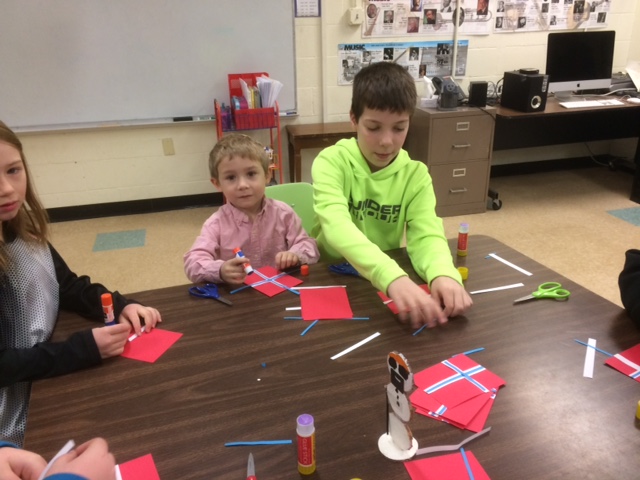
Making flags
Carmine Guica Young Historians: The Cavendish Town Elementary School (CTES) Scandinavian Holiday workshops on December 19 was a lot of  fun. Be sure to check out the Facebook album  to see what the kids made and if you haven’t had a chance to read  “A Cavendish Christmas,” you can read it on-line at the CHS Blog. This is one more tool we are using to help our children know their history as well as be exposed to other cultures around the world. Many thanks to our incredible volunteers-Angela Assermely, Denise Hughes, Peggy Svec and Penny Trick. A special thank you to Lori and the kitchen staff who made Swedish meatballs and noodles as part of the “taste of.” A special thanks to Stein van Schaik and the McEnaney’s Blueberry Fund for helping to underwrite CGYH.

Solzhenitsyn: On Christmas Eve, CHS received a letter of appreciation from Anatoly Antonov, Ambassador of the Russian Federation to the USA. In response to the letter sent to the People of Russia from the People of Cavendish in honor of Aleksandr Solzhenitsyn's 100th birthday, Antonov noted, "On our part, we are grateful to the citizens of Cavendish for supporting the prominent writer, philosopher and patriot of his Motherland for many years that he spent in your town. Taking good care of the Solzhenitsyn family was itself a contribution to preserving and promoting of the great visionary." Both letters appear at the CHSblog.

If you have questions or wish to volunteer with CHS, please call 802-226-7807, e-mail margocaulfield@icloud.com

BECOME A MEMBER, RENEW YOUR MEMBERSHIP, DONATE: If you have not joined the Cavendish Historical Society, need to renew your membership, and/or would like to be a volunteer, please complete the form below and sending a check, payable to CHS, to CHS, PO Box 472, Cavendish, VT 05142. All contributions are tax deductible.

Name: _______________________________________

Address: _______________________________________________


Phone Number: _____________________E-Mail: ________________________

Membership Level
__ Individual Member $10         ___ Senior Member 65+ $5  ___ Sustaining Member $500
__ Household Member $15        ___ Contributing Member $250                                  

Volunteer
___ I would be interested in serving, as a volunteer .I would be interested in serving on the following committee(s):__ Program Planning      __ Fundraising __ Building (Museum)
__Archives                     _ Budget         ­­–– Cemetery    __ Carmine Guica Young Historians

Donations are always welcome and can be designated as follows:
__ For general purposes              __ Young Historians                  __Publications
__ Archeological Activities                _ Museum & Archival             __ Special Events
__ Rankin Fund                           __  Williams Fund                   __ Solzhenitsyn Project
__ Other (please specify)                        __ Cemetery Restoration           __ Preservation Projects


Wednesday, December 26, 2018

Letter from Russian Ambassador to the People of Cavendish

As part of honoring the 100th Anniversary of Solzhenitsyn's birth on December 11, 2018, a letter was sent to the People of Russia from the People of Cavendish. The letter, which was read at the Solzhenitsyn Conference in Moscow, reads as follows:


November 13, 2018


To the People of Russia:


For 18 of the 20 years he was exiled from Russia, Aleksandr Solzhenitsyn and his family lived with us in Cavendish, Vermont. The Solzhenitsyns were then, as they are now, good neighbors, respected and valued members of our community.

While we are sad when residents choose to leave, we were glad that Solzhenitsyn was able to return to his “motherland,” as he predicted he would at our 1977 Cavendish Town Meeting. No matter how much our countryside may have reminded him of Russia, and allowed him the time to write, it would never compensate for the country he cared so deeply about.

Solzhenitsyn’s values were a good match for our Yankee way of life-hard work and the ability to speak freely and openly, yet also respectful of others and their privacy. While he learned from us how grass-roots democracy works, we in turn were reminded of the importance of providing sanctuary to those in need and the value of having courage and strong beliefs.

Upon his departure, Solzhenitsyn left the town not only autographed copies of his books, but more importantly, a homestead, which allows his children to remain an integral and important part of our community. The lessons he instilled in his sons are shared with us as we work together to resolve the thorny issues of 21st-century life. 

Every town needs a secret, such as the one we kept: “No directions to the Solzhenitsyn’s home,” as it united us for a common good. We still do not give out directions, but we do welcome visitors from around the world.

On this the 100th birthday of Solzhenitsyn,  the people of Cavendish extend our best wishes to the people of his homeland.

On behalf of the people of Cavendish,

Margo Caulfield
Director, Cavendish Historical Society

Brendan McNamara
Cavendish Town Manager

On Christmas Eve, the Cavendish Historical Society received the following letter from Anatoly Antonov, Ambassador of the Russian Federation to the USA:

December 18, 2018

Dear Ms.  Caulfield,

Your letter to the people of Russia on the occasion of Alexander Solzhenitsyn's 100th anniversary has been conveyed to President of the Russian Federation Vladimir Putin and is highly appreciated.

On our part, we are grateful to the citizens of Cavendish for supporting the prominent writer, philosopher and patriot of his Motherland for many years that he spent in your town. Taking good care of the Solzhenitsyn family was itself a contribution to preserving and promoting the legacy of the great visionary.

Taking this opportunity, I would like to extend my warm greetings on the occasion of forthcoming Christmas and the New Year, I wish you and to all people of Cavendish sound health, happiness and prosperity.

Sincerely,

Anatoly Antonov


Tuesday, December 11, 2018

Today, December 11th, is the 100th birthday of former Cavendish resident Aleksandr Solzhenitsyn. A Soviet dissident, Nobel Prize winner for literature, and author, Solzhenitsyn spent 18 of his 20 years exiled from Russia living in Cavendish.

In honor of his birthday, the following letter was sent, on behalf of the people of Cavendish, to the people of Russia, where it will be read at the conference being held in Moscow.


November 13, 2018


To the People of Russia:


For 18 of the 20 years he was exiled from Russia, Aleksandr Solzhenitsyn and his family lived with us in Cavendish, Vermont. The Solzhenitsyns were then, as they are now, good neighbors, respected and valued members of our community.

While we are sad when residents choose to leave, we were glad that Solzhenitsyn was able to return to his “motherland,” as he predicted he would at our 1977 Cavendish Town Meeting. No matter how much our countryside may have reminded him of Russia, and allowed him the time to write, it would never compensate for the country he cared so deeply about.

Solzhenitsyn’s values were a good match for our Yankee way of life-hard work and the ability to speak freely and openly, yet also respectful of others and their privacy. While he learned from us how grass-roots democracy works, we in turn were reminded of the importance of providing sanctuary to those in need and the value of having courage and strong beliefs.

Upon his departure, Solzhenitsyn left the town not only autographed copies of his books, but more importantly, a homestead which allows his children to remain an integral and important part of our community. The lessons he instilled in his sons are shared with us as we work together to resolve the thorny issues of 21st-century life. 

Every town needs a secret, such as the one we kept: “No directions to the Solzhenitsyn’s home,” as it united us for a common good. We still do not give out directions, but we do welcome visitors from around the world.

On this the 100th birthday of Solzhenitsyn,  the people of Cavendish extend our best wishes to the people of his homeland.

On behalf of the people of Cavendish,

Margo Caulfield
Director, Cavendish Historical Society

Brendan McNamara
Cavendish Town Manager