Sunday, April 26, 2020

The Relevance of "One Day in the Life" to Covid-19


While Cavendish can recognize the writer Aleksandr Solzhenitsyn as the town’s expert on social distancing, they may not be aware that his first novella One Day in the Life of Ivan Denisovich is a “how to” manual for surviving challenging situations.

Growing up listening to and reading stories of the Holocaust and other atrocities of World War II, I often wondered how people survived such situations. As a teenager, I read One Day in the Life of Ivan Denisovich and found myself saying, “I get it.”

What struck me was the importance of living the moment you are in as well as not obsessing over things you have no control over.  Basically it was my first look at what today is called “mindfulness,” with a bit of Stoic philosophy thrown in.

In the midst of the worst sort of misery-a gulag in the dead of winter-this prisoner achieves a level of contentment that many wouldn’t have thought possible. Laying a brick, carefully and deliberately not only keeps him warm but keeps him focused, engaged and mindful.

I hadn’t re read the book until I started working on the Solzhenitsyn project for the Cavendish Historical Society (CHS). When I revisited it, I was blown away when I read the last few paragraphs of the book.

Having described in detail the challenges of being in a labor camp as a political prisoner, Solzhenitsyn describes what his character does before falling asleep. "Shukhov felt pleased with life as he went to sleep.  A lot of good things had happened that day.  He hadn't been thrown in the hole. The gang hadn't been dragged off to Sotsgorodok.  He'd swiped the extra gruel at dinnertime.  The foreman had got a good rate for the job.  He'd enjoyed working on the wall.  He hadn't been caught with the blade at the search point.  He'd earned a bit from Tsezar that evening.  He’d bought his tobacco.  And he hadn’t taken sick, had got over it.

Today there is a fair amount of research  in the field of positive psychology that support an association between gratitude and an individual's well-being. In part, it helps to create and sustain hope. Interestingly there is research that indicates that those who count their blessings before going to bed actually sleep better.

As it turns out, a very successful and highly practiced form of psychotherapy, Cognitive behavioral therapy (CBT), has its roots in Stoic philosophy. Since one of the most famous Stoic’s was Epictetus, who was born into slavery, it’s not surprising that Solzhenitsyn would have drawn some similar conclusions. We may not have control over our circumstances, but we can control how we interpret them and how we respond to them.

In the midst of our “stay at home” order, “One Day in the Life” is definitely worth a read. It’s short, can be read in one sitting and can help reframe this time of Covid-19 by reminding us that we do have control over how we respond as well as there are positive things happening all around us that we can be grateful for.

There are six English translations of the book, with the one by H.T. Willetts (New York: Farrar, Straus and Giroux, 1991) being the version recommended by the Aleksandr Solzhenitsyn Center.

Thursday, April 16, 2020

Cavendish & Vermont Flu Pandemic 1918


In the midst of Covid-19, we’ve been asked about what Cavendish went through during the 1918 flu pandemic. While there are certainly parallels between 1918 and 2020, at the moment, with the Stay at Home order in place, we can’t access town records, particularly death certificates.

According to Bruce McEnaney, Cavendish Historical Society (CHS) board members and town sexton, who has looked through 1918 records, he said a number of people had “Spanish flu,” influenza or “l’grippe” listed as the cause of death.

We will update this article once we are able to check town records.

Just as in January 2020, the media was obsessed with presidential impeachment hearings, so too was the focus directed elsewhere in 1918. In the midst of World War I (WWI) the first case appears to have been reported in Kansas at Fort Riley in March of 1918. In three weeks, over 1,100 of 56,000 troops were admitted to the hospital and 38 of them died.

Because Spain was not involved in the WWI, their media was free to report heavily on the flu, which is why it became known as the “Spanish” flu.

On Sept. 21, 1918, Charles Dalton, secretary of the Vermont State Board of Health, ordered local health officers to report any influenza cases. While the state’s newspapers carried his warning that the epidemic would reach Vermont in the coming days or weeks, the flu was already here. At the same time the papers posted Dalton’s warnings, they were also including that 40 students at Middlebury and 60 at Norwich University were already sick from it.  More than 50,000 Vermonters would contract the flu and more than 2,100 would die.
UVM Gym converted to care for flu patients.

As we have seen Vermont’s government struggle with closing down schools during the Covid-19 epidemic, their predecessors had the same fears. The Governor of Vermont in 1918, was Horace Graham. He wrote to Dalton on Sept. 26, “Do you not think some general action ought to be taken by the Board with reference to this epidemic. If it is contagious what about permitting all these conventions and meetings(?)” The Governor had other issues to consider as he was worried what effect banning gatherings would have on the sale of Liberty Bonds to fund the war in Europe.

While we see similar masks today, not exactly 6 ft apart.
Dalton issued an order to local health officials stating they had the right to close schools, churches, and other places of public assembly. Note that the state was leaving this in the hands of the local health officers. Dalton also stated, “Health officers should make it plain to all persons that the disease is spread by coughing and sneezing in public or around other people.”

Funerals were allowed, though if you were sick you weren’t allowed to attend. The massive numbers of deaths took precedence over war news.

Finally, on Oct. 4, Dalton ordered the type of “stay at home” order we are now experiencing, as he ordered all schools, churches and theaters closed, and prohibited all public gathers. The ban was lifted on Oct. 31.

Just as scammers are quite active during Covid-19, the charlatans of their day promoted Dr. Williams’ Pink Pills to “ease the stress of families of the ill. A clothier in Barre insisted everyone needed a raincoat as dampness was linked to illness. Vick’s VapoRub was another cure all being promoted.

Global travel as we know it today, did not exist then. However, because of WWI, the troops brought it with them and it quickly spread throughout the United States, Europe and the rest of the world.

The flu came in three waves with the first in the early months of 1918, the second in the fall of 1918 and the third in early 1919. Of the three phases, the most-deadly was the second wave. 

According to the Vermont Historical Society, First noted in reports coming from Fort Devens, Massachusetts, where American troops were assembled for transport to Europe to fight in World War I, the disease quickly spread into Vermont through the transportation centers of St. Johnsbury, St. Albans, White River Junction, Rutland, in the more densely populated communities of Burlington and its neighboring towns, and—most severely hit of all—Barre and Montpelier.

The disease typically ran its course in three weeks, but could kill victims in three days or less. Without the aid of antibiotics or antiviral medicines, physicians were unable to treat cases of flu or its complications, most frequently pneumonia. They were therefore reduced to making diagnoses, treating symptoms, and recording the cause of death. Newspapers carried advertisements for patent medicines, none of which was truly effective in preventing or curing the flu. Makeshift clinics were assembled in churches, libraries, and other buildings. The hospitals in Barre and Montpelier hastily constructed new wings or added a floor to accommodate the flood of patients. In Burlington, the mayor took the unusual and controversial step of opening a dispensary where flu victims with signed notes from their doctors could acquire carefully measured quantities of alcoholic beverages, thought to be a preventative medicine. A critical shortage of doctors, nurses, and medical facilities developed by mid-September, so that Vermont Governor Horace F. Graham turned down the desperate call of Massachusetts Lieutenant Governor Calvin Coolidge for doctors from Vermont. The senior class of medical students at the University of Vermont was pressed into field service; newspapers called on healthy and capable women to take on nursing duties.

By the end of September and into early October, town medical officers began exercising their authority to close all public meeting places—schools, churches, places of entertainment—and a statewide ban on public meetings went into effect on October 4. The Vermont Supreme Court, after postponing its October term several times, finally cancelled it altogether. Middlebury College was quarantined, and the University of Vermont postponed opening its autumn term.

The flu subsided in November—just as World War I came to an end—but scattered and less severe outbreaks persisted into February 1919. Statistics reported by the Board of Health for 1918 show the devastation. In a state with a population of 355,956 in the 1910 census, there were 43,735 cases of influenza in 1918, resulting in 1,772 deaths. The disease thus attacked 13 percent of the population and accounted for 25 percent of deaths for the year. These were approximate figures only, and do not include cases and deaths from pneumonia.

The epidemic had devastating effects on social and family life in Vermont. Because the Spanish flu had the peculiar pattern of fatally attacking people in the middle years, many children were left with one or no parents and were sent off to live with relatives elsewhere. In hard-hit communities, the deaths came so rapidly, in such great number, and under the stress of quarantine, that funeral ceremonies and interments were frequently performed unattended by mourners.

Cavendish was impacted by the flu, just as much as the rest of the state and country. Of the four Cavendish men who died in WWI, three died from flu. As Barbara Kingsbury noted in her book Chubb Hill Farm and Cavendish Vermont,  “The Civilian population was hit hard by Spanish influenza, too, though it spread the quickest in the crowded Army barracks and camps. The epidemic caused much more suffering on the “home front” than any fuel and food shortages."

To get a better idea of how many people in Cavendish may have died from the flu, we’ve used “Find a Grave” to determine how many people died  Sept-November in 1918. There were 19 burials in the Cavendish High Street Cemetery for that year. Of those with month of death, nine people died during that time frame. Hillcrest Cemetry in Proctorsville 11 deaths but few had the months listed, so it is difficult to determine what might have been flu deaths. However, this cemetery only had 4 burials the previous year, so it is expected a number of them were flu related.  

Do your part. Stay Home or 6 feet apart wearing a cloth mask or scarf. 

Tuesday, March 24, 2020

Cavendish’s Best Known Social Distancer: Aleksandr Solzhenitsyn


Due to the coronavirus (Covid-19) pandemic, we’ve been using some form of the slogan, Be smart and do your part! Stay home or six feet apart for several weeks now.

Needing some artwork to help promote the four Ss of prevention- social distancing; soap & sanitizer; stay home; and safely cough-I found myself thinking of replacing the last part of that slogan with “Stay Home and Make Some Art.”  Who better in Cavendish to exemplify that then Aleksandr Solzhenitsyn?

Having spent eight years in a Gulag-prison labor camp, where he was deprived of the opportunity to write in the manner he needed to, he then dealt with a repressive Communist government once he was released. While the rest of the world celebrated his literary works such as “As One Day in the Life of Ivan Densovitch,” “Cancer Ward,” and “Gulag Archipelago,” he was “hunkered down.”

Coming to Cavendish in 1976 gave him an opportunity he may have never thought possible-wonderful light, quiet, mountains, four seasons, a supportive family and a community that was willing to protect him from the prying eyes of the press and the curious.


Was he a recluse or was he really socially distancing for his art? I think the latter.

Just before  Vermont’s governor issued a statewide emergency shut down due to Covid-19, Jennifer Stowell dropped off a copy of the Autumn 1983 Vermont Life, which includes an article “The Solzhenitsyns of Cavendish.”

I’ve been spending my “stay at home” time re reading this article.

The remotely controlled gate and camera that have been installed at the entrance to the driveway, and the fence around the property, have led people to conclude the Solzhenitsyns dislike visitors and prefer to live in seclusion. Mrs. Solzhenitsyn was eager to dispel that impression.

“it’s absolutely not true,” she says. “Maybe it seems that way to people who want to see him whom he doesn’t want to see. But he doesn’t have a feeling that we’re secluded. …The necessity of having a gate and turning away visitors is “very unpleasant for us.”…The fence, she adds is “just for snowmobiles and journalists.” When we laugh at her remark, she adds quickly, sharing the humor with us, ”journalists without agreement,” and then turning serious again, she continues, “because it really interrupts his work and our lives.”

Her husband’s lifestyle is Spartan, and his needs few, she says. “For him, two things are important when he’s writing: quiet and lots of light. He’s completely indifferent to cold. He can work in a cold room. And he’s completely indifferent to food. He can eat the same thing day in and day out. He claims he has everything he needs till the end of his life and doesn’t need more. I can’t even persuade him to buy shirts and pants. He’s like many men-he hates to go into stores. That was true in Moscow, long before we came to Vermont. But he does like quiet and light.”

The article includes photographs showing Solzhenitsyn chopping wood, writing and living the Cavendish life, quietly, privately, and a distance from the town village.


This article includes other insights that are quite relevant for our time. “Television, a staple for many American youngsters, is watched very little by the author’s three sons…The boys are allowed to watch one cartoon show each week, and the oldest son, Yermolay, has the self-appointed task of watching the evening news of television and reporting to the family the events of the day.”

That is a very helpful tip. Once a day update is more than sufficient at a time when headlines, news feeds and commentators can quickly bury you with information that will either be reversed the next day or turn out not to be anywhere near as dreadful as first thought.

Oh and the shopping. Now that’s one we all need to take seriously. There is more than enough to go around so absolutely no need for panic buying.

If we have to be practicing social distancing and staying at home, we are as fortunate as Solzhenitsyn was as we can walk in the woods and not see anyone if we so choose. While he truly stayed home for his art, we will continue to do our part and stay at home so we can keep each other safe.

I asked Ignat, who is very much a part of the Cavendish family, to select some passages from his father’s works that he thought maybe useful during these challenging times. I particularly liked his choice From Repentance and Self-Limitation in the Life of Nations: "After the Western ideal of unlimited freedom, after the Marxist concept of freedom as acceptance of the yoke of necessity—here is the true Christian definition of freedom. Freedom is self-restriction! Restriction of the self for the sake of others!

However, even with our mountains and fresh air, as everything has been shutting down, people are expressing how they feel the world is closing in on them. I find myself turning to one of my favorite Solzhenitsyn quotes for comfort, “We are creatures born with inner freedom of will, freedom of choice-the most part of freedom is a gift to us at birth. External, or social freedom is very desirable for the sake of undistorted growth, but it is no more than a condition, a medium, and to regard it as the object of our existence is nonsense. We can firmly assert our freedom even in external conditions of unfreedom.” From Under the Rubble

Other quotes that Ignat selected

From In the First Circle, Chapter 60 "The great truth for Innokenty used to be that we are given only one life.  Now, with the new feeling that had ripened in him, he became aware of another law: that we are given only one conscience, too. 

From The Gulag Archipelago, Part 4, Chapter 1, “The Ascent”  Gradually it was disclosed to me that the line separating good and evil passes not through states, nor between classes, nor between political parties either—but right through every human heart—and through all human hearts. This line shifts. Inside us, it oscillates with the years. And even within hearts overwhelmed by evil, one small bridgehead of good is retained. And even in the best of all hearts, there remains… an unuprooted small corner of evil.”

From his address to the International Academy of Philosophy, Liechtenstein, 1993: "No, all hope cannot be pinned on science, technology, or economic growth. The victory of technological civilization has also instilled in us a spiritual insecurity. Its gifts enrich, but enslave us as well. All is interests, we must not neglect our interests, all is a struggle for material things; but an inner voice tells us that we have lost something pure, elevated, and fragile. We have ceased to see the purpose."
*******
"It is up to us to stop seeing Progress (which cannot be stopped by anyone or anything) as a stream of unlimited blessings, and to view it rather as a gift from on high, sent down for an extremely intricate trial of our free will.”

               Be smart and do your part. Stay home or six feet apart.
                             Keeping Cavendish Safe and Healthy

Friday, March 20, 2020

WAS THERE EVER A TIME IN OUR HISTORY SIMILAR TO NOW?

Cavendish are making reminder signs.


In view of the coronavirus (Covid-19) pandemic, the Cavendish Historical Society (CHS) is suspending it’s series “Cavendish Women You Should Know” in order to provide stories of how Cavendish has dealt with crisis in the past.

Cavendish has certainly dealt with its fair share of disease over the years. In 1911, activities for the 150th anniversary of the signing of the Cavendish Charter had to be postponed due to a small pox outbreak. This was far from the only time Cavendish dealt with epidemics and pandemics.

Barbara Kingsbury wrote in “Chubb Hill Farm and Cavendish, Vermont,”  The doctors were kept busy with various epidemics. In 1903, there were cases of small pox. In 1906, the Barber family was quarantined for diphtheria and the house fumigated. Dr. George Buxton, Town Health Officer after mid-1906, also posted cases of measles and whooping cough that year. Thirty-four families were quarantined with whooping cough the summer of 1906. In December, William Densmore had scarlet fever and both his home and the Densmore schoolhouse had to be fumigated. The town payed the Health Officer for his time in checking and posting all cases of infectious disease and fumigating, so, some years it was an expensive business. Since whooping cough appeared the same year there had been a case of diphtheria, the town paid for throat cultures to make sure there was no more diphtheria.

Covid-19 epidemic reminds me most of the response mounted after Pearl Harbor was bombed.

Yes, the United States knew what was going on in Europe, but they weren’t prepared, to lose a significant portion of the Naval fleet to Japan’s attack on December 7, 1941. Sound familiar? However, the Americans with their can do spirit, immediately went to work.

Before long there were ships in the ocean, planes in the skies and troops on the ground. Everybody “did their bit.” Winston Churchill, Prime Minister of England would later comment, that among his first thoughts after the US declared war, was “We have won the war.” Are other countries thinking similar thoughts now that the Covid-19 pandemic has arrived here?

In Cavendish, Barbara Kingsbury wrote, “Residents of Cavendish listened to the radio news with mounting anxiety and were as aware of the international situation as other ordinary citizens anywhere in America. ….As soon as war was declared, there were classes on how to spot enemy planes, rules for air raid drills and blackouts, a Red Cross War Drive, and an announcement that Springfield machine shops would train women for the work force. Two observation posts for aircraft were set up in Cavendish, one on School Hill above the Duttonsville School house, and one on Field Hill [East Hill, across from Moonlite Meadows farm]. There was one post in Proctorsville. These were manned by volunteers who usually took a two hour shift apiece. ..They had to learn to identify both friendly and enemy airplanes and were to report on everyone one seen.

In early 1942, rationing of several items was instituted. Cavendish people had to sign up their ration coupon books at their local school. It was confusion at first, but people soon learned the system. Sugar, meat, butter, lard and coffee were the main foods rationed. Sugar and butter were not too big a problem for farm families as maple syrup and butter could be made at home. It was more difficult for non-farmers….To several Cavendish women, the rationing of shoes was the worst blow.

Gasoline rationing took effect in May. 350 gas rationing cared were issued to Cavendish motorists. ,,,Tires were in short supply. It was hard for farmers to get new parts for their machinery.

Defense savings stamps were sold to school children and rallies were held to sell war bonds. ..Price controls and rent controls were established in 1942. Drives to collect scrap iron and rubber were held. Amid the meetings of the Farmers’ Clubs, the Sunshine Society, and the Home Demonstration Club, were Red Cross Home Nursing Classes and Civil Defense meetings. …There was excitement and camaraderie in the feeling that all were working together in a crisis. People were sobered, however, when word was received in August, 1942, that Kenneth Hodge was missing in Corregidor.

That can do spirit is very much alive and well in Cavendish. The community is pulling together. People are volunteering to help those who need to remain at home, others are offering classes on-line and everyone is connecting via the Cavendish Vermont Facebook page and the daily briefings on the CavendishConnects blog. Even our children are making artwork to help remind people of the importance of social distancing as well as creating Cavendish Cares bags to help those who are sick.

Unlike WWII, when many women went to work at Gay Brothers Mill, we are now being asked to practice social distancing and to “hunker down.” Schools and colleges are closed with students learning remotely. While some have lost their jobs, others are telecommuting from home. People are just as concerned about food shortages, as recently shoppers to Ludlow were greeted with empty shelves. For some reason, there has been a stock piling of toilet paper, which did not appear to be an issue during the war years.

 Anxiety today is similar. While we’re working to prevent anyone from becoming infected with Covid-19, they were constantly checking the skies for bombers and lived in fear of a telegraph or letter informing them of a loved one being missing, imprisoned or confirmed dead.  

The biggest difference is duration, WWII was years long, while we will most likely be “hunkered down” in terms of weeks or possibly months. When this current crisis passes, and it will, we will be a different community.

After WWII, Gay Brothers Mill, the town’s largest employer, started laying people off and it wasn’t that long before they closed. Many found work “out of town” at General Electric in Ludlow and for the first time, more people were leaving the community daily than any time before in the town’s history.

Interestingly, with the increased number of people telecommuting, we may see the reverse of that with more people working in town.

However it plays out, the outcome of a strong spirited community will remain here in Cavendish.


Sunday, March 8, 2020

Young Women Entrepreneurs: Taylor Tice


The Cavendish Historical Society continues its Young Women Entrepreneurs series, as part of Women’s History Month. Last week’s post was about the artists Lily Calabrese and Miranda McNamara.  

Taylor Tice of Outer Limits Brewery: A girl and her brewery!

Taylor is from Westport, CT but came to know Cavendish because her father bought a second home here, as well as attending Okemo Mountain School (OMS) as a freestyle skier while a junior in high school.

Checking out her options, Taylor went to Montana State, and two years at Johnson and Wales in culinary arts, before graduating from Ithaca College in public and community health, with an emphasis on sustainable foods.  

Having met her husband in Ithaca, they were living in Maine, where Wesley had turned from organic farming to brewing, when her Dad told them about the building adjacent to Svec Park (formerly the Proctorsville Green). One look and they knew this was the building for them.

It wasn’t an easy process getting the brewery up and running-opening weekend was July 4th. Taylor’s initial focus has been the food. While she is clear that they are brewery that offers food, not a restaurant, her interest in sustainability can be seen in what they serve.

The spent grain from the brewing process is turned into sourdough pretzels and country-style baguettes thanks to Sweet Surrender bakery. SpringMore Farm in Baltimore, VT, who uses the brewery’s spent grain for their pigs, is talking about a bratwurst for the menu. Outer Limits uses local ingredients whenever possible.

With excellent kitchen staff , Taylor is turning her focus on managing the Tap Room, as well as caring for their daughter Isabella, who just turned 3, and preparing for a new baby boy due May 11. As if that weren’t enough, she’s exploring possible programs and events for Svec Park come summer. One idea is a once-a-month “art in the park.”.

There isn’t a lot of time, but when possible, Taylor loves to go to music concerts, and if she’s not pregnant, hitting the slopes for skiing.

Monday, March 2, 2020

CHS Briefs March 1, 2020


Please also check the Cavendish VT Facebook page for photo albums of various CHS activities.

NEW AT THE CHS BLOG
• The 2020 “Cavendish Women You Should Know” series for Women’s History Month began on March 1. This year we are featuring Young Women Entrepreneurs, women in their 20s and 30s who have started and are running their own businesses. This first week we are featuring two artists, Lily Calabrese and Miranda McNamara. Read on-line.

WHAT WE’VE BEEN DOING
Theme for the 2020 Season:  “Seeing the World Through Technology” will be this year’s CHS theme. Technology has changed how we see our world, this timely theme allows us to juxtapose ideas of traditional Yankee ingenuity with exploration of innovation, visibility, and expression that are relevant to our present day. Our first program will be on March 29 (Sunday) when we present the video of Ignat Solzhenitsyn’s talk “Writing the Red Wheel in Vermont.” Without the benefits of a publishing company, Solzhenitsyn was “self-publishing” with the help of his family, including his young sons. The meeting will be held at the Cavendish Baptist Church at 2 pm.

Carmine Guica Young Historians: Our annual school wide holiday program-this year focusing on Winter Solstice and the making of luminaries-was both fun and educational. With the new year, we’ve been working on programs for the remainder of the school year. As part of the Preserve and Serve program, the students held a fundraiser for Australian Fire Relief. They raised over $1,300.

Logo designed by our Young Historians
Our home school students are once preparing “Cavendish Cares” bags. These contain items for those having the flu. We did this several years ago and were asked to do it again, particularly with the concern regarding the coronavirus. If you would like to support the students in this effort, you can drop any of the following supplies at the Cavendish Baptist Church through the side entrance at the back of the church - through the double doors under the porch supported by crosses. There will be a bin labeled "Cavendish Cares Donations" just inside those doors.
• Tissues
• Paper towels
• Disinfectant wipes
• herb teas
• cough drops
• lip balm
• hand sanitizer
• ibuprofen
• acetaminophen
• dried soup mixes

March is one of our favorite months because it’s St. Patrick's Day, which provides a wonderful opportunity to talk about the Irish influence on Cavendish.

Spring trips are being planned, as well as more community projects. If you know of someone that could use help in preparing for the warmer weather ahead-planting, gardening, bringing summer furniture outside etc.-please contact us by phone 802-226-7807 or e-mail margocaulfield@icloud.com

Stone Church: A memo of understanding has been signed between the town, CHS and the Aleksandr Solzhenitsyn Center (ASC) regarding the completion of the restoration and its ultimate use as the permanent home of the Solzhenitsyn exhibit as well as a small venue space. A Stone Church committee has been set up to work on this project. Members include Brendan McNamara (Town Manager), Margo Caulfield, Bruce McEnaney and Kem Phillips (CHS); Rolf van Schaik (citizen and former Town Manager); Ignat Solzhenitsyn and Stephen Plunkard (Landscape architect). At the annual meeting on March 29, we should have some renderings from Stephen on the landscaping for people to review and comment.

UPCOMING EVENTS
March 29 (Sunday): Annual Meeting 2pm at the Cavendish Baptist Church on Main St. Cavendish. In addition to a short business meeting, we will be review any landscape renderings for the Stone Church and will be screening Ignat Solzhenitsyn’s talk “Writing the Red Wheel in Vermont.”

May 23 (Saturday): CHS Annual Plant Sale. 9-noon in front of the Museum. Please pre order “Salad in a bucket” or “Tomatoes to Go” by e-mailing margocaulfield@icloud.com or calling 802-226-7807. We will be doing some deliveries prior to the sale.

May 24 (Sunday): The CHS Museum opens for the season. The museum is open 2-4 on Sundays, and other times by arrangement.

Saturday, February 29, 2020

Cavendish Women You Should Know: Young Women Entrepreneurs-Artists


March is  Women’s History Month. To celebrate, the Cavendish Historical Society (CHS) once again hosts the series “Cavendish Women You Should Know.” This year’s focus is “Young Entrepreneurs.,” women who in their 20s and 30s have started and are running their own businesses. Each weekend, throughout March, we will be featuring a different young woman entrepreneur.

We begin the series with two artists, both of whom graduated from Green Mountain Union High School (GMUHS) and are avid snowboarders, dog lovers and volunteer for the Cavendish Town Elementary School’s (CTES) Snow Sports Program.

Lily in her gallery to be!
Lily Calabrese of Lily Calabrese Pottery: The youngest of our entrepreneurs at 25, she is a CTES, GMUHS and University of Vermont (UVM) alum. 

Lily discovered pottery at GMUHS thanks to Mr. Lima. While an environmental science major, she joined a pottery coop at UVM and before long she was selling her work at Frog Hollow and teaching.

After graduating from college, she returned to Proctorsville and set up a studio at her father’s house. Before long, she was selling her work at craft shows, Stemwinders in Ludlow, farmer's markets and has participated in the July Town Wide Tag Sale the last two years. Yes, she does plan to be at this year’s event, with her incredible deals on seconds. However, she’ll be set up at her home/gallery on Main St. directly across from Svec Park (Proctorsville Green).

Lily says she is inspired by nature and wants to make fun things to brighten up a home. While there is a whimsical quality to her clay dog heads and other sculptural pieces, she also paints intricate patterns on some of her platters, plates and bowls. Each piece is unique and shows her creativity, love of design and a desire to explore and experiment.

In addition to her pottery business, Lily is a semi-pro snowboarder. She rides for GNU and heads out west several times a year. Some may remember that Lily won best in the state while in high school.
Lily in competition. We love our lady riders.

Like many in Vermont, Lily has worked multiple jobs and is known for her reliable skills as a pet sitter. Lily grew up with cats and goats, but more recently took on the responsibility of her first dog, Angus. A real sweet heart, she sometimes brings him to shows.

Lily is in the process of setting up a gallery space at her home, which will not only feature her work but also other artists, including Miranda McNamara.

Miranda in her welding gear.
Miranda McNamara of Miranda Kae Jewelry: Originally from Chester, Miranda is a graduate of Hallmark Institute of Photography in Turners Falls, Mass. Like Lily, she found the roots of her craft at GMUHS. Running out of art classes to take, she began exploring silversmithing in the metals workshop.

A selection of Miranda's Jewelry
After completing her program at Hallmark, she returned to Chester and started working for The Rock and Hammer  in Bellows Falls. However, the “Great Recession” in 2008 found Miranda without a job. The layoff became the impetus to create a workshop in her parents’ Chester home, and thus Miranda Kae Jewelry was born.

With the arrival of two children, Miranda took a break from her business. In the interim, she and her husband Brendan McNamara purchased a home in Cavendish, where Brendan is now Town Manager.

As Maryn and Brogan started attending school/preschool, Miranda returned to her jewelry. Today, after dropping off the kids at CTES, she
The Studio!
heads to her studio in Chester and works until it’s pick up time at 3 pm.

With the goal of moving the studio to her Cavendish home, she has the advantage of her Dad’s workshop and welding equipment, another skill she explored in the metals workshop at GM.

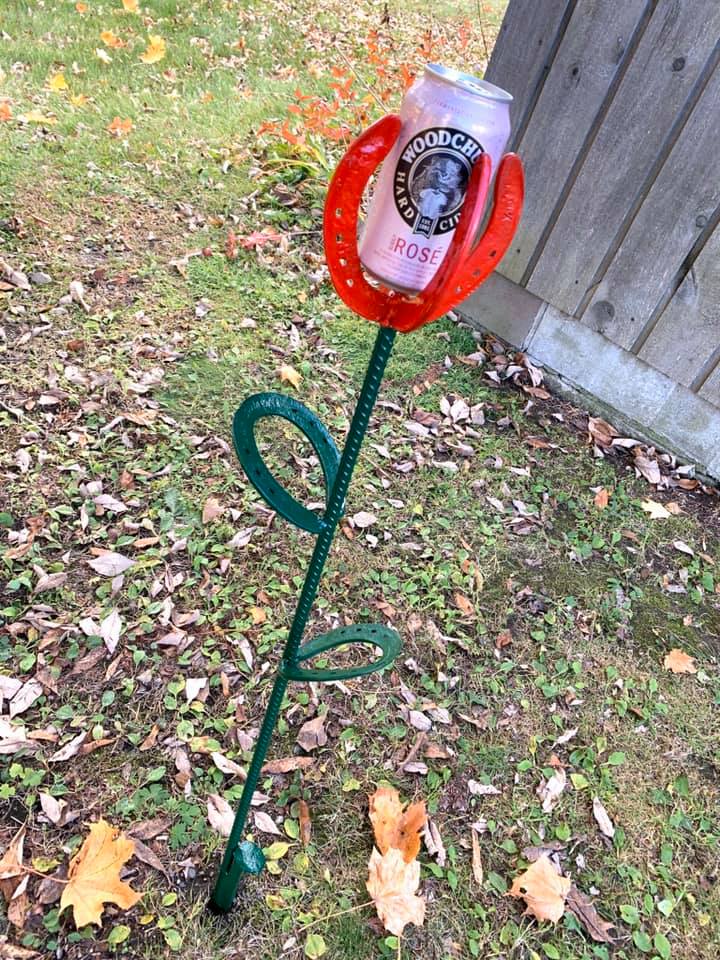
Drink stand from horse shoes and railroad spike.
She loves those rusty items, and recently finished her first piece of found objects welded together to create a drink holder.  Note the old railroad spike welded to the base so it makes it easier to push into the ground.

A puppy moment in a very busy life.
Have some old rusty metal you want to get rid of? Contact Miranda so we can all be amazed at how she can re-purpose discarded metal into art and functionality. She does this all the while balancing life as a mother, wife and pet parent to two puppies.

While Miranda has been primarily selling from her Facebook page, you’ll be able to find her this summer at local farmer’s markets as well as Lily’s new gallery.